

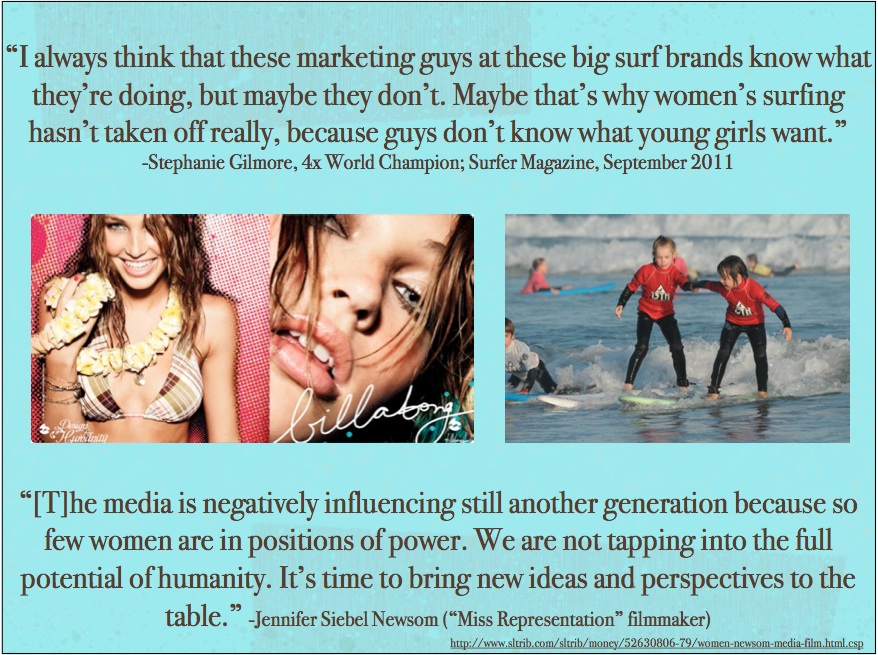
Beyond the opinions of whether sex sells or not, and all the attendant questions often overlooked in this simple cliché (e.g. What does sex sell, exactly? Does sex effectively sell every product/service? How does this marketing strategy impact society? Are men and women equally drawn to the sexualization of human bodies? Are men and women equally impacted by the sexualization of bodies?), there exists a growing body of evidence that for athletes in particular, sex does not sell athletic products or athletic events, nor does it positively impact the perception of an athlete’s talent or ability. To this last point, the sexualization of athletes, male and female, has been increasingly shown to negatively impact perceptions of their talent and ability.
For the demographic that does respond positively to female athletes being sexualized (males, 18-34), it does not automatically follow that this will increase their interest in female sports. Quite the contrary has been shown. Males of this demographic do not “come for the pudding and stay for the meat,” as it were. So, for example, when pro surfers and surf commentators express that having Alana Blanchard, who has “arguably the most ogled ass in all of professional sport,” on the women’s professional surfing tour is a good thing for women’s surfing in general (given that she has over 700,000 instagram followers largely due to her emphasis on modeling and sex appeal, which she admits to in an excerpt from a Cooler Magazine interview below), this is a patently unfounded opinion born of the “sex sells” cliché that has gone too long unexamined.
Does it help the sport?
“I think it does, it’s probably half the reason why I made it, it got my name out there. I remember when I was 15 I hated it, but then Rip Curl took me along me to all these photo shoots and now I’m so thankful that they did. Now I know how to model. I think it’s a good thing for all the girls on the tour.” -Alana Blanchard
Opinion and fact collide in sport over this topic and it is imperative to pull apart the strands in order to better view where and when sex does and does not sell.
It is important to note the distinction between 1) images being sold that promise sexual arousal for arousal’s sake (magazines, videos, pornography), 2) images being used to manipulate non-human-product perception (relocating sexual desires via marketing to clothing, hats, watches, cars, wetsuits), and 3) humans as products (athletes, rockstars, movie stars, celebrities). I do not subscribe to the consumerist position that human beings are themselves products (the most vapid objectification of humanity) but I will address this since we are working within the realm of consumerism when we discuss the efficacy of selling sex for monetary gain. This is not meant to be an exhaustive look at advertising dynamics but ought to serve as a starting point to better examine these ideas in sport in particular.
1) Sex does sell magazines. Products that are visual (e.g. videos, magazines, pornography) trend well for men when females are sexualized. However, using the research above (which you can find in the Roxy Petition Delivery Packet here) and applying it to sports magazines, we know that when a female athlete participates in these sexualizing endeavors, the perception of her abilities decreases. In addition, the female athlete’s career, based as it is on endorsements rooted in image, will be short and, I would argue, largely banal.
“If you are a hot, young female surfer that has that ‘Maxim Magazine sex pot’ thing going for you, this industry is going to love you… The only downside is your shelf-life in the spotlight will be limited because there will always be younger, cuter girls coming up to replace you.” -Keala Kennelly, The Inertia
An example from the past that challenges the Blanchardian assumption that sex appeal will somehow translate to heightened interest in women’s surfing, is Wendy Botha. She garnered 4 world titles, equalling Lisa Andersen and Frieda Zamba for most titles ever, yet is “better known for her spread in Playboy than for her incredible sporting achievements.” Despite the fact that the Australian Playboy magazine she was in was the “first-ever issue to sell out,” women’s surfing of this era did not benefit from Botha’s exposure in the least.
2) Sex does not sell athletic clothing or athletic events. To what extent this applies to a company like Roxy that flirts with surfing in the gap between athletic/beach lifestyle and competitive sport should not be underestimated. Rebecca Olive does a great job pulling apart the lifestyle/sport support dynamic that Roxy has involved itself in on her blog post “Roxy press release: Please buy our stuff!”
“And look, Roxy doesn’t have to promote female surfers or sponsor surf events. It’s great that they do but they don’t have to. Except that, well, it’s been a key part of their company image. They keep telling us that promoting women’s sporting opportunities and female athletes is core to the values of their brand, so when they slip up, it makes them look shitty. It puts cracks in the PR and reminds us that they are, after all, just a company trying to sell us stuff.” -R. Olive
Plenty of marketing research has pointed out how important it is to match endorser and product in advertisement. That is to say, if Danica Patrick is to endorse a product, it better be related to cars.
“Great commercials, but I still have no idea what Godaddy.com actually is.” -youtube comment on a Go Daddy commercial
GoDaddy, who used Patrick to endorse its products in ads replete with sexual double entendres and ridiculous sexism, seems to have learned this lesson and made public their move to distance the brand from its original risque marketing amidst great push-back from female business owners and those they do business with online.
“There is another way to advertise, [chief executive of godaddy.com, Blake] Irving said, that ‘doesn’t have to push customers away: still edgy, still fun, still entertaining, still irreverent” but “talking in a more grown-up way, doing things that are hilarious, memorable and don’t polarize.’”
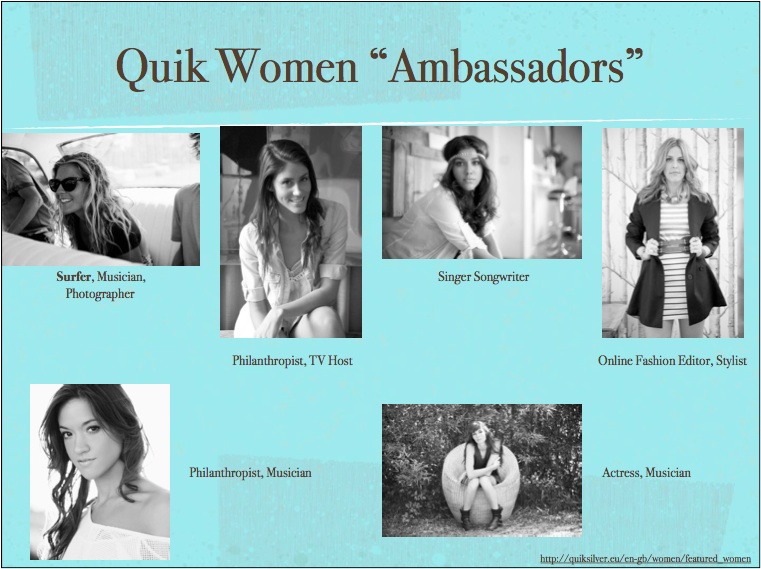
The point in all this is that Roxy needs surfing and surfers in order to relate their products successfully to surfing and to their customers. I would argue that the central reason that Quiksilver Women did not fair well was because it was not connected nearly enough to surfing. Of the original ambassadors of Quik Women, only one was a surfer brought on after QW had already existed for over 2 years. How often she was shown actually surfing by QW while it was still around is negligible.
The troubling thing about this disconnecting trend in the largest women’s surf brand–which I argue is fueled by an arrogance that quips that it does not need women’s surfing as much as women’s surfing needs it–is addressed soundly by Bronwyn Adcock who exposes the very root of the problem of why women’s professional surfing has not garnered the support it might.
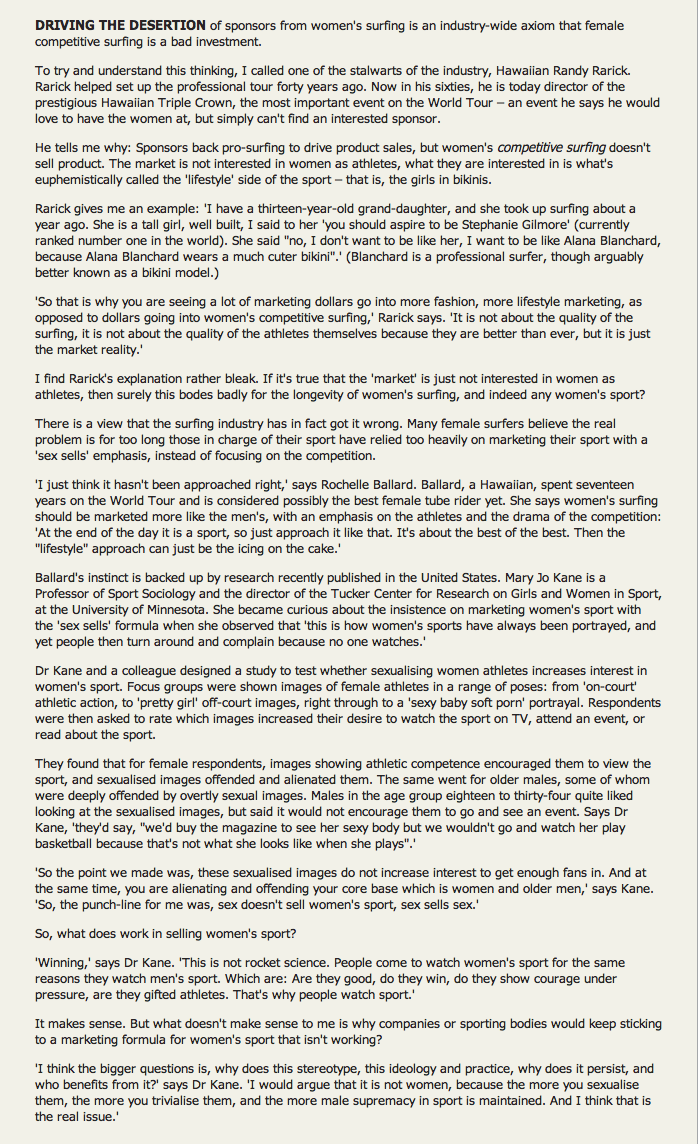
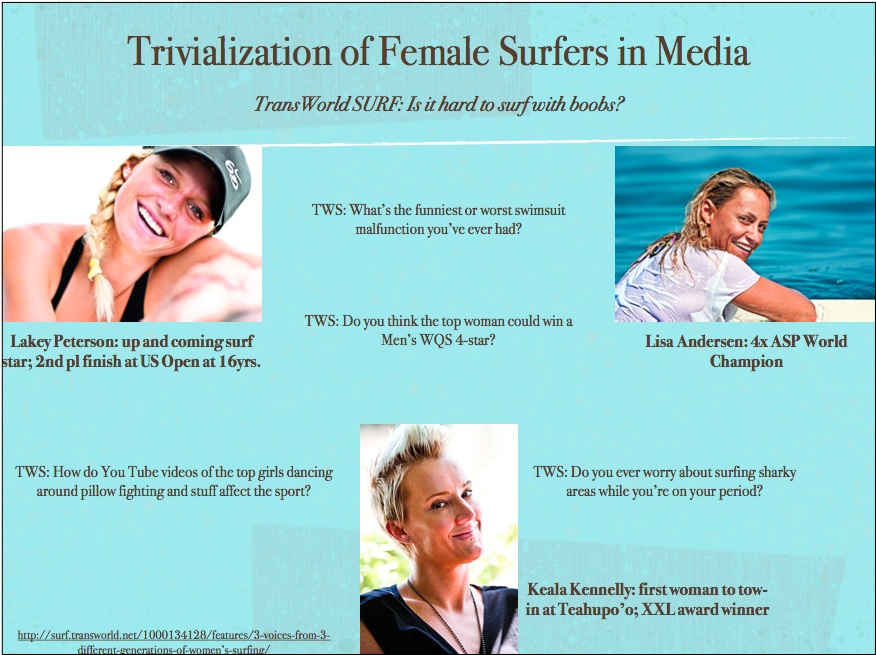
Adcock collapses the ignorant loop that exists within the surf industry regarding women’s competitive surfing in her piece in the Griffith Review. She too uses the recent studies that I have encountered, specifically Dr. Mary Jo Kane’s research, to drive home the idiocy of current and past marketing of women’s surfing. The portion of “Is it hard to surf with boobs?” (the title was taken from a TransWorld Surf article that asked trivializing and ridiculous questions like this to some of the most iconic female surfers in the world) that we are most concerned with can be found below. You can read Adcock’s whole piece, which I highly encourage, here.
Adcock zeroes in on the maddening assumptions made about what women want without the industry actually listening to the female surfers themselves or even allowing space for this dialogue at all. When their own marketing strategies fail, women are blamed. If women create a safe space to try to tackle these issues, they are harangued. Big Surfing (un)reasons that either female competitive surfers are somehow inherently not that interesting or audiences just don’t care about women’s competitive surfing. Rather than turning the mirror around and gazing at their own marketing strategies, strategies that continue to falter, women are blamed? Really?
The growth of women’s surf industry occurred because it was something new and refreshing in the 1990s and not entirely because it was marketed appropriately. What may seem like a lack of women’s pro surfing audience is not due to a lack of interest in women’s surfing but because the surf industry has been caught in its inability to effectively listen to what women want from them and how female athletes are most successfully portrayed.
For example, when female surfers struggled to displace models in ad campaigns by clothing companies, the industry listened… sort of. Now the industry pats itself on the back “We use REAL female surfers in our ads” largely in the same poses and ways they used the models. This is “progress” to the surf industry: instead of sexualizing non-surfing models they now sexualize surfing models. The requirement for female surfers was obvious, if they wanted to make more money and gain more endorsements, they would have to play both model and surfer (with all the attendant issues that accompany being a model piled atop the demands of being a world class athlete).
Here we are sitting in the midst of a great opportunity when the largest female surf brand in the world is getting direct feedback regarding what its consumers/viewers/fans, along with athletes in boardsports and other sports, want and their response is… ? Exactly what you would expect from an industry that is still caught in this ignorant loop. Why is this?
Sport is the strong-hold of an out-moded, limited masculine identity. Structuring sport in such a way that trivializes and diminishes women’s achievement is done specifically in order to ground traditional masculine stereotypes. This is why I believe that sport is such an important location for feminist action, not only for the good of females but also for males who may fall outside of these limited and limiting masculine stereotypes. Nobody wins in these caricatures of gender and sexuality, not even the brands, in the end. Times have changed. The story has moved on.
3) Here is the hard bit… ladies, sexualizing your “product,” your “business,” your “assets,” may make you money, but certainly not for long and at great cost. It will garner such astounding comments as those found on one well known female surfer’s Instagram: “I will suck that a**, then I will f*** that a**.” It will cause people to question your commitment to your sport and your ability.

There is another cliché that exists alongside “sex sells” and that is “If your product were any good, you wouldn’t need sex(ism) to sell it” and that applies to you (if you tout yourself a product or a brand) just as much as it does any other objet for sale. How you choose to go about selling your product is very much the same choice marketing execs have when choosing corporate brand marketing strategies. To that end, much of what has been said above applies also to you. I would add that if how you are marketing your product is strictly via images (see topic 1) those companies who endorse you in order to drum up purchasing for their products (see topic 2) may soon find a reason to cancel your marketing expertise. Why?
There exists a new element at play in the realm of “product endorsements” at the individual level that has altered the marketing/endorsement game tremendously and bears delving into a bit. There is much emphasis now on building a following via social networking (Instagram, Vine, Twitter, and to a lesser degree, Facebook). The idea is that the more followers, the greater the potential endorser’s reach. In addition to brands investing in advertisements or marketing strategies, the individual herself also plays a role as a kind of networking billboard hub… like the sticker plastered surfboard of a talented surfer at a local line-up magnified by thousands. For a brand, this constitutes a greater degree of “product placement” at a minimal amount of cost.
The problem, as it were, arrives at exactly the moment when followers do not translate into dollars for a corporate brand because the followers are along for the ride solely for the images. We can use the research that applies to traditional marketing and advertising and apply it to this new area of marketing because it is grounded in consumer behavior (which does not change across technology platforms).
“Consumers are human, they will respond, but they’re also smart, well-educated people who will soon realize that they’re being manipulated. People may buy your product one or two times due to the erotic interplay, but if the product isn’t any good, you won’t hold onto the customers for long. Not only that, they’ll feel cheated, talked down to, or outright patronized. And that will take a much greater effort on the part of the advertiser to regain that trust.” -Paul Suggett, Sex in Advertising
The consumers in this scenario are of two types: those who are viewing your images for free and the corporate brand who will soon find that the 700,000 followers are not viewing events nor are followers buying the corporate brand’s non-human products (clothes, wetsuits, phones). This mode of marketing does not bode well financially for your “product” in the long term and as these things go, followers will want more scantily clad images than you may be willing to give, if not now, certainly at some point. Allowing the space to mature and shift beyond scantily clad images is something you ought to allow yourself and in this limiting scenario, this will equal less followers which will in turn decrease the value of your “product.”
I am not going to spend too much time on the choices of individuals because in an environment that does not offer female athletes equity in pay, either in endorsements or in prize money, the choices of these individuals is limited.
Ultimately, the greater task is to focus on changing the culture and to provide individuals (and their parents) with as much information and support as possible so that decisions can be made with clarity and foresight. Knowing the difference between opinion and fact and distinguishing which of surfing’s practices are exploitative (environmentally, politically, and socially) are steps in the compassionate maturing of surfing with a distinct goal of leaving surfing a more beneficent culture than it was handed down to us.


Leave a Reply