
I’ve been taking my 6’0″ out the past couple of mornings. I enjoy the feeling of quick, sharp turns, lip-snaps and the weight/unweight a shortboard offers when the waves have push and a certain steepness to them. I really like messing with my body, confusing my muscles out of their usual neuronal firings in order to keep them open and responsive, flexible and aware. Why spare my body the habits of my mind?
As I was changing out of my wetsuit (a feat that requires advanced yoga) Tuesday, I saw a man approaching out of the corner of my eye. I turned and smiled as I met the kindly gaze of Rabbi Barney, who was headed out for a pre-Hanukkah surf at Pipes. We chatted for a bit and he asked me if I had heard of walking on water… a mutiny of thoughts ran through my head, but my tongue held. I listened.
He spoke softly of a project he had been swept up in, involving surfing and Israel. I wanted to ask about Palestine, but didn’t need to. The Rabbi told me about the effort of those involved in the project, including Doc Paskowitz, to bring surfboards into Gaza.
Last night, I watched the trailer for Promised Land: Israel through the eyes of surfers and recognized Maya Dauber, who I met when I was a very young 19.
1996
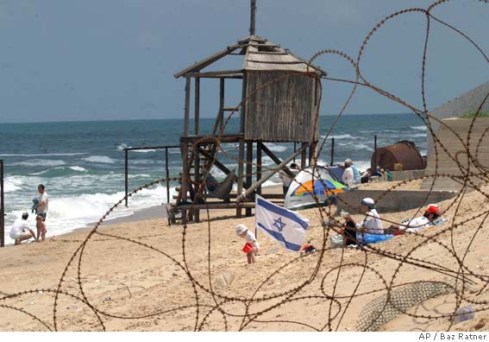
She had an aura of self-assuredness to her that I found foreign and magnetic. She held herself apart from the spectacle of the ISA World Surfing Games, naturally. It was as if her very being had expanded beyond the narrow vision that saw this theater as anything other than a petite distraction. She was relaxed, taking the scene in, neither overwhelmed by the blaring horns or visibly nervous about the taut, anxious bodies of young athletes that were her supposed competitors.
It was as if her mind and her heart were taken up by a different host than many of us, as if the desire to win, to raise a trophy above her head, to excel above a legion of competitors grappling for the same prize were merely entertainment, worthy of some attention, but not all.
I could not understand this at the time. I was enveloped, enshrouded, immersed in the spectacle… drenched in it. So utterly espoused to the tableau was I, that Fernando Aguerre asked me to be the “athlete’s spokesperson” at the Opening Ceremony. I spoke alongside Mr. James Easton, then representative of the Sport and Environment Commission of the International Olympic Committee (IOC) who went on to be Vice President of the IOC.
The event, held in October 1996, was touted as the world’s largest-ever surfing contest. There were 600 competitors in attendance from 36 different nations. I remember Maya, perhaps more than many others I met for the first time at that event, and have found myself thinking of her over the years at random moments. Any time women in the US military come up in conversation or on the news, I think of Maya. Often, when the Israeli-Palestinian conflict looms large in the American political conversation, I think of her.
At 19, I was flabbergasted that they let women serve in active combat in Israel and that everyone had a civic duty to serve in the army. These were ideas that were novel to me at the time. My mind shifted as she spoke of what it was like living as a female surfer in Israel, a place that only lived for me on felt-board, cut-out images and cartoon streets that composed the Sunday School stories of my youth. There were so many questions I wanted to ask her, none of which I was able to collate into an intelligible interrogatory. Really, I just wanted her to keep talking about her life, in all of its political dimensions.
The Politics of Dancing
Politics, simply understood, consists of social relations, often struggles, that involve authority or power. Those who are marginalized, who have little real, human, or social capital are most vulnerable to politics. It is inevitable that some of these folks find their way into sports, onto teams, to podiums, to trophies, to medals, to championships.
There is a general feeling that politics has no place in sport, that we ought to “keep politics out of surfing/skating/snowboarding/sport…” but there really is no way to limit politics in sport because the individuals who are involved in sport must deal with politics on a daily basis, both within their chosen activity and in the broader social context.
Consider John Carlos and Tommie Smith, athletes for whom “keep politics out of…” meant keeping their mouths shut and denying there was still an incredible racial divide and immense inequality for Blacks in the world (e.g. apartheid in South Africa), the Olympics, and in America.
Consider Invictus, and the role of rugby in the politics of South Africa.
Consider women who have been caught in a very real political struggle for all of their athletic careers, forever caught in an uncomfortable tension between performance and a constantly shifting image of the ideal feminine.
Consider LGBT athletes who, by-and-large, spend their athletic careers creating and then hiding behind false selves and masks to avoid political struggle.
Consider those athletes that rise as phoenixes from the ashes of their poverty stricken neighborhoods to become the heroes of our sports.
Consider Promised Land, Rabbi Barney, and Maya Dauber.
Politics in sport is endemic. Behind the scenes of the spectacle of struggle that we watch from the outside (we call this spectacle of struggle “the game,” or “the contest,” etc. and it is marked by relatively fair rules, pronounced sides, clear winners and losers), there is a more entrenched struggle that affects who gets what sponsorship, what salary, and all the strange, biased reasons why, that are not as clear-cut and “fair” as the spectacle of struggle itself.
Denying or decrying the explicit manifestations of the politics of sport (e.g. players strikes) or seeking to silence an athlete’s voice (limiting them to physical expressions alone or constricting their voice to talk only of “the game”) does not eliminate the political struggle itself. As spectators, we often want to have a place to escape to that provides the illusion that unfair, biased, prejudiced, and greedy power struggles do not permeate every centimeter of our lives. But the reality is, we are all caught in the politics of dancing. Politics is where we negotiate these struggles, it’s where the most important conversations happen.
It might be uncomfortable, but we all have to deal with the reality that there are power struggles happening all around us that need our attention, that need us to be present, that need us to unplug from the spectacle, pick up a book, educate ourselves, and then do something about the state of things. By checking out, by ignoring the cacophony, by silencing or demanding the silence of those who speak openly about politics outside of the “appropriate” space for politics, we become complicit in betrayals and abuses of power.
Doing sports outside of the spectacle (corporate funded, big-screen TV, spectated theater), brings people together. Working toward a single goal unites the most disparate, dissimilar people. You don’t have to speak the same language, you don’t have to hold the same political views, you simply have to be committed to the purpose, the goal. This is the opportunity of sports versus the co-opted use of sports as diversion and distraction.
There is a key lesson in this… there is viewing and there is doing. One promotes an “us” vs. “them” dynamic that does nothing to foster compassion or empathy save that of the in-group; the other, promotes empathy and compassion across boundaries and borders. There is ample opportunity to teach and to learn in participation, and in doing so, to grow and to change. To keep the game going, both sides must learn to make compromises and learn to negotiate.
At the end of the day, even our opponents are our team-mates, for without them, there would be no playing of the game. There is respect given to those who out-perform us just as on a different day, there is admiration for those who we out-perform, if the way in which we play is honorable, courageous, and fair.
A mutiny of thoughts

Rabbi Barney asked me if I had heard of Walking On Water… a mutiny of thoughts ran through my head, but my tongue held. Religious conversations are another of those pariah conversations that we are loathe to engage. Though I held my tongue in this instance, knowing that it was a time to receive, the Rabbi and I have exchanged thoughts on a variety of topics related to the more miraculous “walking on water” by a certain Galilean.
The Rabbi and I don’t share the same views on everything*, but in the water, we’ve had some great conversations and exchanged hoots when one or the other catches a good wave. I respect him and appreciate that he doesn’t shirk from tough conversations. That he ended up working alongside Maya on Promised Land: Israel through the eyes of surfers, and that he felt that I would enjoy it given my proclivities, is a masterful stroke in a chain of events set off by allowing politics into sport, at least at a conversational, individual level.
These are the days I love the diversity of the line-up, the connection of those who surf the world over, and know that the admonishment of “keep politics out…!” does nothing more than inhibit one’s capacity to expand, be reflexive, and an individual’s ability to affect change from wherever they are located, contextually or geographically.
(*one might label me a “Humanist: “I am a humanist, which means, in part, that I have tried to behave decently without any expectation of rewards or punishments after I’m dead.”-Kurt Vonnegut)


Leave a Reply