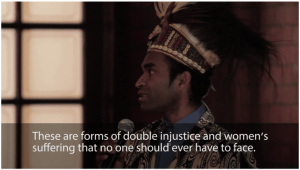
“We have always known this, God has always known this, but now you will know it too. This means that now you are also witnesses. So these stories and our hopes will now also be carried by you.” –Ronny Kareni, Collective Testimony of those who witnessed The Biak Massacre of July 6th, 1998
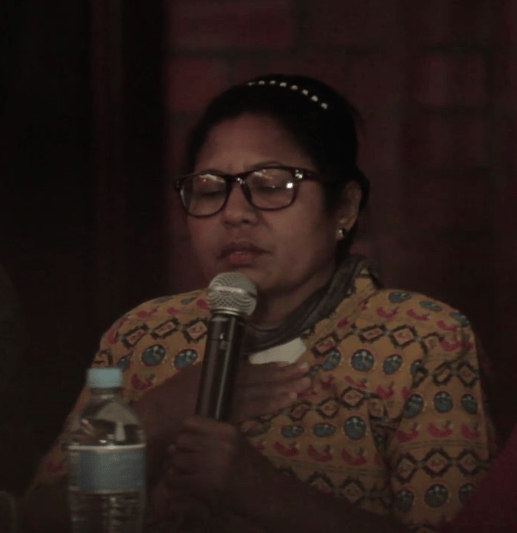
Mrs. Tineke Rumakabu, a brief pause after detailing her torture at the hands of Indonesian military officials.
Listening to the testimony of Tineke Rumakabu about her experience during and after the July 6th, 1998 Biak Massacre, given at the University of Sydney in 2013, took me three days, not because it is all that lengthy, but because it made my blood boil, my skin crawl, and my heart break.
While I could press pause and walk away from Mrs. Rumakabu’s testimony about her and 11 other West Papuan women’s torture at the hands of Indonesian military officials when it became too much to bear (vaginal penetration with melting candlesticks and genital and breast mutilation), but Mrs. Rumakabu cannot walk away from her memories, from the vision of her friend being beheaded after being raped and mutilated in front of her, from the persistent trauma that hangs over those who survive such atrocities.
Mrs. Tineke Rumakabu and translator.
Despite this, Mrs. Rumakabu maintained her composure throughout her hour long testimony, the first time she had openly, publicly discussed her trials. The only time she broke was when she described how, after being accused by Indonesian officials of separatism because she provided food for protestors the day the helicopters, planes, and ships descended on Biak, months after she had escaped naked and bleeding from the clutches of her torturers into the jungle… her husband divorced her. She had become a source of shame for the family because of what was done to her.
The shame that came as a result of the atrocities done to Mrs. Rumakabu, this shame that caused the loss of her husband, was too much for Mrs. Rumakabu… such an effective shame, one that works to doubly victimize women in these terrible situations continually.
Ronny Kareni during his reading of the Collective Testimony of those who witnessed The Biak Massacre.
After collecting herself and before allowing the tribunal to move forward, she asked to make two requests through her translator, “for the dignity of Papuans… so that no one else would have to suffer what I suffered.”
Mrs. Rumakabu asked the Australian government, the Australian Parliament, and the Australian people to urge the United Nations to take an independent team to West Papua to investigate The Biak Massacre.
Mrs. Rumukabu also asked for freedom for West Papua, for its independence from the harassment, cruelty, and the human rights abuses Papuans have been subjected to since 1962, when Indonesia took control of what was then called Dutch New Guinea, a colony of the Netherlands.
A Little History
Why does Indonesia control West Papua when the only trait Indonesia and West Papua share is that they were both Dutch colonies prior to WWII?
West Papua is distinct from Indonesia ethnically, culturally, and linguistically with a rich, indigenous heritage spanning tens of thousands of years, yet West Papua was handed over to the recently formed Indonesian Republic in 1962 by the Netherlands in a move that was encouraged by US President John F. Kennedy and facilitated by the United Nations through their New York offices at the height of the Cold War.
The controversial New York Agreement was brokered without Papuan involvement. The agreement promised a referendum on self-determination for the Papuan people, but the Act of Free Choice that was meant to fulfill this stipulation in 1969 is largely regarded as a fraudulent sham, with only 1,025 Papuans handpicked by the Indonesian military voting in accord with the Indonesian government’s will. The rule of Indonesia was established in West Papua via a fraudulent, coercive process, setting the tone in West Papua over the next 5 decades.
Indonesian rule in West Papua was violently implemented by an Indonesian military that had found its pre-New York Agreement attempts to “liberate” the Papuan people from Dutch colonialism thwarted by the Papuans themselves.
The reason many Papuans rejected initial attempts by the Indonesian military to “liberate” them prior to the Dutch exit was because the Dutch had already established a timeline for Papuan independence… they even had a date set: December 1, 1970. Indonesian “liberators” reported back to their superiors that Papuans were violently rebuffing their efforts and so began the history of vicious attacks against “separatists” in West Papua, foreign and domestic, which continues to this day.
It is important to note that the Indonesian government rejects the existence of indigenous people within its own region of control, actively “deny[ing] any proprietary rights to indigenous peoples in forests… [ensuring] that the government is the sole arbiter of whether indigenous peoples exist or not, a situation that allows the presence of indigenous peoples to be denied when expedient for the Government and denies the right of self-determination from Indonesia’s indigenous peoples.” (source)
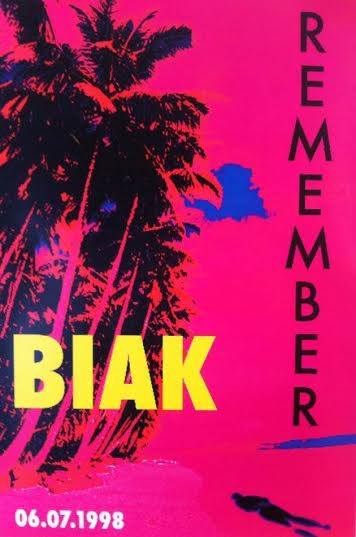
Today, 17 years to the day after The Biak Massacre and 53 years after the beginning of what qualifies as a strategic and invisible genocide (over 500,000 civilians killed by Indonesian military to date), I want to honor those who dare raise their voices against the threats and horrors enacted by the Indonesian government, some of whom have disappeared mysteriously… some of whom are from our surfing community, like Mark Worth, known from The Surf Report; I want to call attention to the fact that there continues to exist an Indonesian media black-out, which prevents the truth of how dire the situation is from making headlines and drawing global attention, which would undoubtedly put pressure on the United Nations to step in and stop the inhumane madness; and to declare my support of the Papua Merdeka! cause publicly.
I will be joining Surfers for West Papua as an ambassador and want to encourage you to help spread the word about this ongoing atrocity in order to increase the visibility of this issue, pressure the United Nations, and to support the courageous Freedom Fighters, like Mrs. Tineke Rumakabu, in their struggle for West Papuan independence from Indonesian tyranny.
One response to “In Remembrance of The Biak Massacre”
Dianne Young
well written Cori, with your help Mrs Rumakabu’s story and the memories of others will be shared and more of the world will be enlightened as to these past and present atrocities

#/media/File:LocationWestPapua.svg)



Leave a Reply