

Conversations about sexism are exactly like conversations about climate change: an overwhelming amount of empirical evidence exists for the damage it causes and what it specifically looks/acts like, pretty much everyone agrees it’s happening, but the causes, the behaviors, both systemic and subjective, that continue to drive it and make it worse, are often presented as a personal choice made in a vacuum with no greater consequence beyond what one subjectively experiences (and we always have the “choice” to ignore it/abstain if we don’t like it, says the “logic”).
This kind of thinking, the kind that naturalizes long-term, damaging trends by privileging the subjective experience to a radical extreme, facilitates the dominant power hierarchies that drive (and benefit from) racism, poverty, unsustainable consumption, destruction of the environment, climate change itself, and oppressions of every kind. This kind of thinking is intimately linked to an ideology that maintains that one’s personal happiness can be tied to presenting oneself as a desired, consumable, visual commodity, and that, in fact, one’s own subjective happiness in the moment is valued above all else, future be damned. In other words, it is the spiritual expression of materialism.
Where materialism demands we accumulate things to be happy, spiritual hedonism mainlines materialistic ideals (bypassing “things”) by demanding we accumulate and consume experiences and cultivate environments that only bring us personal joy (even if this means the often invisible Other suffers), and recoil from anything emotionally difficult or mentally demanding… the line blurs even further when our subjective happiness is attached to attention gained by becoming consumable, visual objects ourselves.
How did we get here? Is our value and happiness really tied to how commodifiable we are? Would it make a difference if people really, deeply understood that the current spiritual paradigm–a “cultural imperialism” birthed in the US–began in the ’60s and ’70s and that this is the exact cultural ideology that allowed the rapid degradation and pillaging of our environment and our planet’s resources? This, in much the same way that Christianity was the spiritual ideology facilitating Europe’s imperial colonialism in the past.
Is it wild to think that focusing on our own personal happiness is the consequence of, not the solution to, the hyper-individualism and constant self-re-creation demanded of destructive neoliberal thinking? Does this sound radical? Extreme? Difficult? Why is it that with such a huge emphasis and value placed on happiness, people in the US are more unhappy, depressed, and anxiety-ridden than ever?
Why don’t we value difficulty the way we value ease? Isn’t this the whole point of “stepping out of your own comfort zone?” Or does this only apply when the comfort zone and the zone of discomfort are outside of us, across a visible boundary line? The comfort zone that sits centrally, at the core of our often invisible beliefs, is the exact location where we must move from, but too often we cannot see the contours or the shape of this place, how it was initially constructed. How high are the walls of this invisible boundary? What discomfort awaits us as we cross this boundary into deeply unknown, alien subjective territories in order to nurture our agency, rather than our status as consumable objects?
“A spirituality that is only private and self-absorbed, one devoid of an
authentic political and social consciousness, does little to halt the suicidal
juggernaut of history. On the other hand, an activism that is not purified
by profound spiritual and psychological self-awareness … will only
perpetuate the problem it is trying to solve, however righteous its
intentions.” – Andrew Harvey
Resources:
*”Rather than create activists, the constant sexualization of women in our society actually discourages them.” (Source)
That Swimsuit Becomes You, sex differences in self-objectification, restrained eating, math performance.
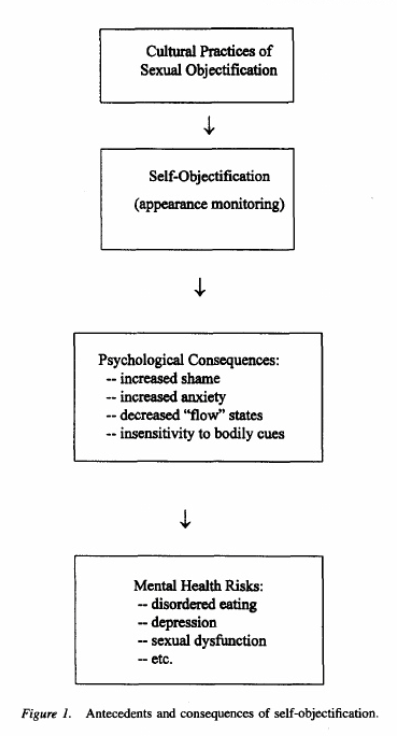
“The consequences of the sexualization of girls in media today are very real and are likely to be a negative influence on girls’ healthy development,” says Eileen L. Zurbriggen, PhD, chair of the APA Task Force and associate professor of psychology at the University of California, Santa Cruz. “We have ample evidence to conclude that sexualization has negative effects in a variety of domains, including cognitive functioning, physical and mental health, and healthy sexual development.” (Source)


Leave a Reply