
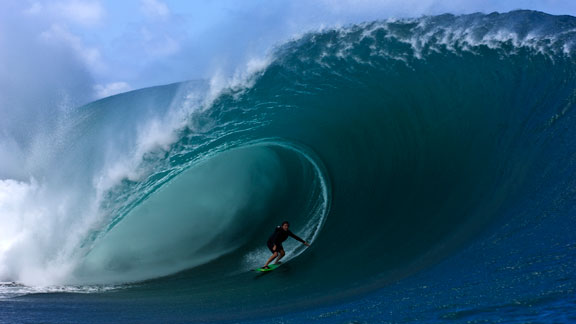
Sexist sentiments that one might expect to find around Maya Gabeira’s surviving a botched rescue attempt after tackling one of the largest waves (if not the largest) ever attempted by a female in a tow-in scenario, I found written by a woman on Surfer Magazine’s website and in comments by industry stalwarts, viz. a couple of noteworthy white guys.
Despite this, I have found that the majority of what is being said by commenters replying to these obvious and not-so-obvious sexist examples is generally supportive of Maya’s efforts and many even go as far as extending to all women who may want to tackle frightening scenarios in the ocean.
The overarching theme emerging from our dialogue with each other is one within which it can be seen that we are progressing, despite the best efforts of a draconian narrative that coughs and sputters along like some persistent fossil.
Stop feeding the vampires.
Published in the June issue of Surfer Magazine, Janna Irons’ article “Boy’s Club” was posted on October 29th as a feature on Surfermag.com after news came in of Maya’s near drowning.
In it, Irons attempts to ground her argument–that there is a biological reason that there are fewer women who attempt big wave surfing than men–with a 2010 study she plucked from the Journal of Strength and Conditioning:
”A recent study published in the Journal of Strength and Conditioning Research looked at the performance difference between male and female as it pertains to surfing and found that women are at a significant disadvantage in regards to peak performance. The study pointed out that men commonly have longer limbs, which allows them to produce more torque through a given movement, which allows them to create greater velocity when paddling. Ultimately, it concluded that women ‘are not physiologically capable of performing some explosive movements equal to their male counterparts even in a relative manner’ and that ‘even relative to body weight, men still have the advantage over women.’ And this study didn’t consider the strength required for big-wave paddle surfing.”
The only study that exists in the Journal of Strength and Conditioning that looks at differences in performance between sexes in surfing is one that specifically studies the explosive force of the upper-body during the pop-up phase of surfing. I attempted to contact Ms. Irons to confirm that this was the study she was using in her article, but received no reply. However, looking at the wording from the study and the quotes she is using, it is obvious that this is the study she is using, while conveniently leaving out “in the pop-up phase” in her referencing paragraph. You can read the abstract here and the full study here.
The merits of such a study that states its intention to generalize from a small group of surfers (20 men and 20 women who surf recreationally) whether women will be able to directly compete against men professionally by studying how fast they can get to their feet is patently absurd. Methodological issues aside (of which there are plenty), one of their base assumptions is already faulty and outdated.
In this study, the researchers use a 1996 summary report that states that longevity of ride is an essential component of the World Qualifying Series professional judging criteria to bolster their hypothesis that the speed of the pop-up in surfing is integral to peak surfing performance.
“This supports the pop-up as a crucial element in surfing performance, because a more explosive pop-up will get them onto the wave quicker thus extending time on the wave. (Eurich, et al., p. 2821)”
While it is no doubt important to have a clean pop-up, I don’t think anyone in their right mind would take this study seriously as it is used without reference or specificity in Irons’ article, which begs the question, why use it at all?
She also wrangles in the inevitable juice in any biologically deterministic argument: hormones. In any such simplistic argument that attempts to dislocate human beings from their socio-cultural environments, the damage and disrespect to both women and men is apparent. In this argument, “Women are physiologically more risk-averse” and therefore lack the desire to attempt challenging situations and men possess “for lack of a better word, [the] balls” physiologically required. Women run from risk while men rush towards it through some biological imperative embedded in their hormone-addled minds. She attempts to correct for this diminishment of human behavior to our physio-chemical make-up by stating that “Of course, there are exceptions…”
Yeah. Every human being is an exception to this reductive hogwash, frankly.
Irons’ article is important to highlight in order to draw attention to the fact that it is not just men who peddle this nonsense. If you read the comments beneath this article, in fact, you’ll find many men who outright disagree with Ms. Irons. Some even point out how her argument is damaging to male surfers as well and female surfers.
“Men look at women. Women watch themselves being looked at. . . . The surveyor of woman in herself is male: the surveyed female. Thus she turns herself into an object.”
-John Berger, “Ways of Seeing”
Women can be just as bad at peddling this bullshit as men since we are conditioned to see ourselves in certain contexts and must actively work at seeing ourselves in a non-sexist, non-objectified way. Many of us buy into the draconian narrative and suck the energy out of those working to alter the very ideology doing the damage. Carry this unfortunate reality over into conversations around “sex sells”… It really is a matter of conditioning how we see ourselves, as well as how men see us, isn’t it.
Surf Patriarchy.
There are specific circumstances where I will invoke the concept of patriarchy and the surf patriarchy is most certainly one. As illustrated above, the surf patriarchy is not limited to white, heterosexual men, but to those who wish to maintain their own status within such a system.
That being said, this whole Nazaré debacle has certainly offered up some points from which to view the creaky groanings of this group.
It is an essential component of the surf patriarchy that those within it are well established, respected, and highly achieved surfers with decades of experience in many, if not all, areas of Big Surfing. They have a voice, reach, and impact within surf culture and many also have a more expansive reach than this.
However, this does not make of their perspectives some unbending law that deserves mindless obeisance. I would argue that their status and voice demand more attention and more questioning because of their influence and power within the culture.
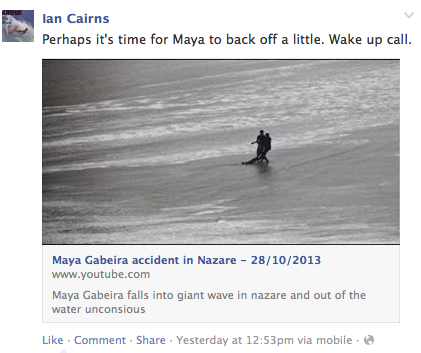 To that end, when Ian Cairns and Laird Hamilton, in what I have no doubt came from care for Maya’s well being, oh so publicly question whether she should be surfing mammoth waves after surviving a giant wipe-out and making it in to the inside of Nazaré via her own volition and then succumbing to a jet-ski rescue gone bad that could have happened to anybody, I must call foul.
Question someone’s skill in large surf, please. I encourage this and hope it extends to males as well, especially in today’s era of “gladiators” and “manning up” and giant paychecks being floated to those chasing mountainous surfer-killers in open seas. I have no doubt these conversations occur amongst those who are actively engaged in surfing massive waves.
And it is here, between those engaged in the activity, that those conversations belong, not in a patronizing Facebook post that shows Maya completely disabled and being lugged from the ocean helplessly, or in a television interview during which a surf patriarch who was not present at Nazaré (but who assures us he could have been) diminishes both Maya and the male Brazilians who dared the impossible that day (Carlos Burle may have set a new record for largest wave ridden, but Laird publicly questioned the intensity of the wave). Here’s what Garrett McNamara, who was at Nazaré with Maya, had to say:
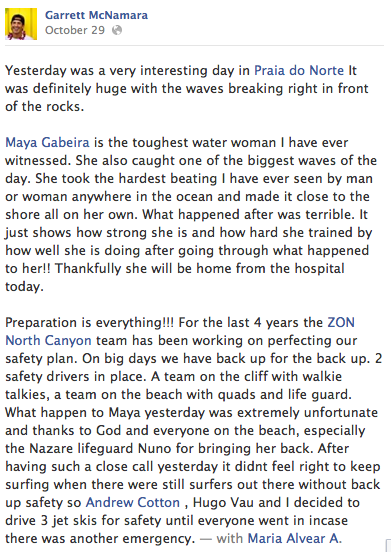
Diminishment is a trademark of the surf patriarchy (or any other group seeking to maintain their own status and power), that those who challenge the status quo are diminished, trivialized, or ignored. For women, we get the patronizing care of implicit sexism, as if we don’t ourselves know how to calculate the risks associated with death-defying endeavors, as well as more overt forms.
Yet this is also how we know we have shifted and are progressing as a culture in our conversation around sexism: I have witnessed Cairns and Hamilton both being called out by commenters for one of the more difficult to see forms of sexism, that of paternal care.
The reason for this support amidst the protective? Maya is doing exactly what we, in our mode as a purportedly meritocratic culture, have deemed necessary to gain respect. Charge. Go. Don’t back down. Don’t give up. Be courageous, undaunted, brave. More than any photo shoot she has ever done, more than any feature in magazines or glamour shot, this act is a game changer.
Are there consequences for this type of behavior? You bet there is. But how many paradigm shifts have you heard of that didn’t leave a little blood on the reef? Do I like that this is the case? Hell no. Would I prefer the shift was one in the direction of more compassion and less death-defying demand for our male heroes? Absolutely.
Perhaps we ought to start seriously considering meeting in the middle.


Leave a Reply