
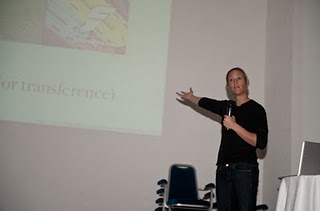
Photo Credit: Alba Pardo
I woke early the day I was to give my presentation at the Women in Boardsports retreat in Saas Fee. I had stayed up quite late the night previous in order to ensure I had noted the elements I most wanted to communicate. I had taught myself Keynote in the process of putting the presentation together and had begun to take notes but decided to limit them in order to attempt a more spontaneous approach while on stage.
Initially, I thought an hour would be a massive amount of time, but that time passed in a flash as I discussed the problems and I found the time I had to discuss solutions was sorely limited. I have expounded upon them here. (You will find the problems I discussed within the presentation slides at the bottom of this post as well as the positive examples I found in Volcom’s website and 2009 ad campaign)
There are several things that I feel strongly will positively influence the future of women in boardsports:
Women need to EDUCATE themselves on the current state of how women and girls (both athletes and models) are being represented by our boardsports industries from a sociological perspective. It can be difficult to see ads, media stories and websites for what they are actually communicating because we see these images so often. We are entrenched in the very culture that gives rise to advertisements and media. Often, we don’t find anything strange in what we see, although “…sexualization in media leads to increased eating disorders, increased depression and lower self-esteem among girls.”
Altering the context of ads, media and websites, pulling them out and peering at them with a new lens is a helpful way to see what is being communicated. Branding, ads and ad campaigns don’t just sell product, they sell culture. The more we know, the better able we are to identify what we wish to change, communicate why we wish to change it and understand just how the cumulative effect of such social texts impact the socialization of our youth.
Some education resources:
The Geena Davis Institute, home of the largest studies on gender in the media ever done.
American Psychological Associations report on the sexualization of girls.
We need more VISIBILITY of positive role models in boardsports. Instead of rewarding hyper-sexuality with visibility, ads, ad campaigns, sponsorships, etc., we need to make visible those who are complex, intelligent, pro-active, creative, talented women in boardsports. We ought also to support women who are creating projects to bring female role models to the forefront of our cultural consciousness. This galvanizes the identification of young girls with subjects rather than objects. This is incredibly important to the healthy development of self in that girls will better develop a sense of self from the inside out, instead of from the outside observer’s gaze, in: body-image linked to one’s feeling of worth.
Some visibility projects:
Stark Raving Madeleine
Jenna Selby
Lorene Carpentier’s Oceanides
We need to ENCOURAGE the abandoning of lazy, short-cut marketing that surrenders to “sex sells” and reward those companies that reconnect with the creativity and artistry that make our boardsports industries unique. Through verbal, written and monetary feedback, we need to communicate with boardsports companies, and to each other, our likes and dislikes.
I would love to see the boardsports fashion industry focus on developing and encouraging their sponsored riders to create designs and authentically engage in the design process while committing to artistry rather than pushing short-term profit seeking through their trivialization, sexualization and objectification.
Summer Rapp, the woman who was integral in helping Volcom create a women’s line and who also played a major role in Quiksilver Women and Roxy, argues that the industry could use more artistry and creativity:
“Now days the industry is very competitive with fast fashion—forcing product to get cheaper and deliver quicker—and as a result the industry as a whole has become very homogenized.”
“Designers aren’t as free as they once were to create,” says Rapp. “That’s a bummer in my book.”
“At some point we made the entire process way too complicated,” she continues. “When it worked best was when we did what was innate to the brand, and when we were more hands on in design…When I worked with Volcom, we had a hands on tech and pattern team and we would spend quality time working with our pattern maker to come up with unique designs. That was the most intimate time in action sports; the design teams, who were very passionate about their styles, also managed product development. Now days most companies develop via merchandisers and just have tech teams, but no pattern makers—the true artists. We need to get back to the basics!”
We need to SUPPORT programs that introduce and mentor young girls through boardsports. This helps to develop a deeper relationship between girls and boardsports, one that is not simply about learning the lifestyle, but is more focused on developing a sense of self, a sense of well-being and a healthy sense of self-esteem, self-efficacy and mitigates the negative influences of our culture on young girls. This is a very positive place for boardsports companies to impact young girls through sponsoring these programs. But they must be facilitated, not by brand managers or fashionistas, but by people outside of the companies who are dedicated to the holistic health of these young girls.
Sports itself is a powerful method of mitigating the influence of media, peers and the sexualization of girls. Encouraging young girls to participate in any sports organically primes them for pushing boundaries, being resilient and self-assured, thus counter-acting the negative influences of bullying, unhealthy body-image issues and the internalization of sexualization (to name a few positive influences; see presentation for more). But if sports is allowed to be co-opted by companies that focus more on the bodies and image of girls rather than their achievements and actions, then a very powerful opportunity is lost.
I am certainly not saying that we eliminate sexuality completely. Women are sensual, sexual beings, but the objectification of women to sell product, the constant, narrow representation of women as passive objects present for someone else’s sexual pleasure, is frustrating and limiting at best, or as some studies suggest, the first step leading to violence against women. Ultimately, there must be a balance struck between sexuality and action and women need to be the ones setting this balance.
One of the most difficult things to comprehend is the internalization of sexualization at play today. The internalization of sexualization of young girls is perfectly acceptable to many. “She said she wanted to wear/do that.” or “Some girls are just like that naturally.” But what if we re-frame this? What would the internalization of a set of beliefs look like from an alternate perspective? The difference here is that now you are viewing, not a societal norm that many accept, but a minority belief, a belief that was so important to the few who believed it, that they killed themselves because they had internalized it so thoroughly. This is the power and scope of internalization.
Seems like an extreme example until you step into the shoes of a foreigner who has never heard of or seen before a woman injecting her lips with a viscous mucous until filled to bursting, or slicing open her chest to insert giant balloons of liquid or older women sacrificing the dignity of age for skin pulled so tight they cannot blink their eyes or a young woman who cuts herself repeatedly, scarring herself to feel… to feel anything. Are our norms harmless? Does this not constitute the long-term internalization of a misogynistic violence? We do this to ourselves!
(Just for fun, try substituting a race or ethnicity in this sentence: “Some _______ are just like that naturally.” Alters the tone a bit, doesn’t it? Completely brushes off cultural, historical and environmental context, ignores a possible stereotype threat, what an individual’s past is… it’s bogus.)
In looking at the effectiveness of a set of internalized behaviors or beliefs (which we all have), it is necessary to question the efficacy of such behaviors and beliefs in action. What one values, what one wants from life is directly affected by what one has internalized. When we question the persistent objectification and “pornification” of our sisters and daughters and we are told “this is what they want” and then we hear that they want to accomplish something in the world as the subject of their own story rather than simply the object of another’s pleasure, there is a dissonance that must be pursued, questioned and untangled.*
(*edit: 12/15/2011- To expand on this point, the dissonance here noted emerges from wanting to be the subject of one’s own story- active -while surrendering to the pressure to be the object of another’s desire- passive. Being objectified makes of a girl/woman a passive object that is acted upon rather than acting herself. Those girls/women who allow themselves to be objectified limit their efficacy, their being-as-active in the world. This understanding is vital to communicate to our sisters and daughters.)
How an adult lives their life is invariably that individual’s choice. But allowing young girls (and boys, for that matter!) the freedom to develop at their own pace, in a healthy environment that does not bombard them with trivializing slogans, hyper-sexual interpretations of femininity and clichéd, shallow role models is a duty we must all embrace.
The slides of my presentation follow:

The slide presentation “From ‘Stand by Your Man’ to ‘Stand by Your Suntan’:Women in boardsports from a surfing perspective” is licensed under a Creative Commons Attribution-NonCommercial-ShareAlike 3.0 Unported License.


Leave a Reply