

An increase in the visibility of apologist voices, propped up by a slowly wasting status quo, arrives in a culture at the moment a robust transition is beginning to gain traction. In the movement against sexism and gender inequality in surfing, this trend is no different. Alongside the rise in apologist voices, is a renewed thrust to remark the boundaries between an “us” and a “them” that defines a culture’s identity. This is an exploration of both of these trends in action sports, using surfing as an example.
Apologists and Opposites
 In the last issue of Surfing Magazine, we saw an example of a feminine apologist rhetoric during an interview with Coco Ho in response to the question “What are your thoughts on where women’s surfing is at right now?”:
“We’re doing pretty well as female surfers — I don’t think we deserve more yet. The feminists are going to kill me, but all I’m saying is, right now, we don’t deserve as much as the guys. In some jobs, women totally deserve as much because they’re doing the same work. We’re doing the same job as guys but at a different level. Our competitive level is slowly getting where it needs to be and the prize money is following. We don’t need to be out there petitioning and fighting because it’s already happening. It’s growing at the right pace.”
Darcy Roland has taken Coco’s privileged, laissez-faire attitude to task with spot-on accuracy in a recent article. During the course of a conversation about the progression of women’s surfing, Coco expressed that she felt that women’s surfing was progressing “naturally.” Read in the context of another issue of Surfing Magazine, it is easy to see how this idea of the culture of surfing “naturally” progressing is being used to warp the history of women’s surfing.
Surfing Magazine’s highly problematic June 2012 issue claimed that women’s surfing was being “reinvented” in a feature that implied some Darwinian “natural” selection: “Adapt or Perish – Four ways surfing is self-modifying for the better.” In this June article, the men over at Stab Magazine were credited with being “the architect of this adventure,” an adventure that marks the new ladies as “tote-ally [sic] hetero” and “hotter than fish grease.”
In this telling, it is the male-dominated status quo, not the many women who have done the work through the decades, who congratulate themselves on being “progressive“ (a word I use with heavy emphasis on the ironic quotation marks).
This works to silence and obfuscate the great history of feminist work in surfing, severing current generations of women from their activist mothers and grandmothers and fostering the idea that it is through a quiet, well-behaved, demure acceptance of the paternal, patronizing care of the status quo that we progress as females within the surf culture.
What I wish to cull from this particular moment, rather than reiterating what Darcy Roland’s excellent article has already covered, is connected to the intention behind Surfing Magazine’s choice to highlight two particular bits of Coco Ho’s interview. In txt parlance, these would be screams:
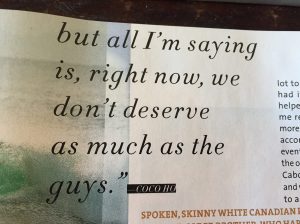
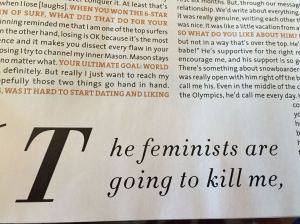
Why is it important to note the intention behind the use of these quotes that scream out at readers in this interview? And how does this relate to a recent advertisement campaign by RVCA?


“RVCA pitch themselves as an art, surf, and skate brand with a company bio that states. ‘Transcending the boundaries of traditional action sports apparel….it is about inspiring our generation, providing something of substance and culture and above all doing it with integrity.’
RVCA Spring’s 2014 collection video questions the substance and integrity of this brand.The use of smooth slow-mo and lo-fi shots, are reminiscent of leaked celebrity sex tapes in which the male gaze is present and as the model look’s straight into the camera, she engages with the male observer. Women watching this advert may be subject to feeling’s of insufficiency as the ‘topography’ of the feminine body is continually in question (Mulvey 1996:5).
The cosmetic industry relies on the ‘investment’ that a patriarchal society makes in the female form, by interpolating and hailing the reader in to her investment in capitalism. Thus confirming, the action sports industry use female insecurity in order to sell product, in turn allowing consumers to achieve a hegemonic stereotype.” -Emma Shoesmith, Action Sports as a Microcosm of Gender Inequality: Changing Perspectives, 2014(see note at bottom about Shoesmith’s dissertation)
Rather than upholding their commitment to substantive creativity and “integrity” (whatever this means from a company who snuggled up to the increasingly irrelevant Big Surfing corp, Billabong, in 2010, ostensibly to lend BBG a much needed youth cult boost),
“It probably isn’t cool anymore for the youth of today to wear Billabong.”
RVCA marketing has instead adopted ROXY’s creatively bankrupt strategy of pornifying their women’s marketing under the overtly sexist narrative of a “Balance of Opposites.”
On the one end of the narrative binary (Fig. A, left), we have the subjects: active, skating males, while on the other extreme (Fig. A, right), we have the passive object upon which the active element is expected to work upon: the sexually objectified female imbued with the exact shades of ROXY’s controversial event trailer, complete with a near identical female body lolling about half-naked in bed.
Objects are always interchangeable, replaceable, and substitutable. Objects lack identity, feelings, individuality, ability, and agency. This is why we use the term “objectification” when we talk about these kinds of portrayals of women.
Subjects, on the other hand, are the beings that have agency. We are meant to relate to the subject (a persistent, boggling marketing faux-pas on the part of brands who wish to be relatable to women) who is at the center of a given narrative.

“[I]t’s remarkably easy for us to… objectify something that really does have feelings. It’s been a political tactic to dehumanize anything (or anyone) a group in power wants to use and abuse. In an image, we feel with the subject, and look at the object.” (Subjectify Me: 5 Ways to tell if an Image is Objectifying.)

Couched in this “balance of opposites” is an extremely worn Global North metanarrative that works overtime to maintain a seemingly natural binary that pits active/reason/Industry/male (Industrialization, Fig. B) against passive/emotional/Nature/female (Nature, Fig. B). Knowing the fundamentals of this narrative is essential to unlocking the maladaptive perspective that lies at the center of action sports’ monoculture and can help us understand why these types of sexist representations persists, despite repeated efforts by both women and men to cease such limiting representations.
“…these ancient notions of reason and masculinity were not only maintained but strengthened with the rise of science in the Renaissance and the seventeenth century. ‘Our inquiry confirms that neither the equation between mind, reason, and masculinity, nor the dichotomies between mind and nature, reason and feeling, masculine and feminine, are historically invariant.
Even though the roots of both the equations and the dichotomies may be ancient, the seventeenth century witnessed a marked polarization of all the terms involved — with consequences as crucial for science as for our own understanding of gender’ (Keller 1985, 44).
An example is Sir Francis Bacon, arguably a founder of modern science. Bacon describes the proper goal of science to be a ‘chaste and lawful marriage between Mind and Nature that will bind [Nature] to [man’s] servitude and make her [his] slave’ (Farrington 1951, 187).
Bacon’s marriage would be one in which ‘the emphasis was on constraint, on the disjunction between mind and nature, and ultimately on domination of woman by man’ (Keller 1985, 44).” (link)

In the billboard by RVCA (Fig. A), which uses this exact hierarchical framework that flows beneath the surface of our humanity, continuing to polarize the ways we categorize each other and our environments (an ecofeminist might accept this binary and offer the scintillating Q&A: “How have we as an industrialized/male-dominated world treated nature and women? The same, toward violent and destructive ends.”), we are not shown anything like a “balance,” but are instead treated to the same, repetitive narrative that is the domination by the active masculine of the passive feminine, even if postponed in the imagination until the boys are done skating. The viewer knows what reward awaits these concrete warriors. Can we not see this same narrative illustrated nearly everywhere in action sports?
Surfing, for instance, is awash with stories that reflect the “man/industry vs. female/nature” metanarrative that uses war rhetoric to dramatize competitions and big wave feats. Male surfers are warriors, spartans doing battle with technological wonders beneath their feet, out to conquer/gain dominion over the sea (always female). The sea, nature, woman… all to be acted upon by men, by industry, with the tools and technology of the precise, rational, scientific mind.
It has only been recently (as women have gained traction in typically male dominated arenas like the military, business, sports, etc.) that this same rhetoric is being hesitantly, almost apologetically (“but she’s also so humble and so nice… always smiling and happy…”) applied to female surfers.
With this shift has come an increase in representations of women that dissuades the seemingly fragile male-ego from the imagined threat of a truly empowered, active, physically liberated female (surfing) body. A note: I’ve always held that the way marketing and media treat men, just as with women, is demeaning and limiting. Men can handle, would in fact thrive, in an equal, balanced culture. Not a culture that objectifies men and women equally, but one that celebrates the unique subject-hood of each individual. This, in fact, is my favorite part of the teleology of feminism, to liberate human beings from these restrictive, demeaning, and very worn out gender scripts.
The narrative of “balancing the opposites” works only to serve the masters, and does not bring any real balance of equality. Representations, like RVCA’s, and the highlighted quotes in the Coco Ho interview, intentionally work to waylay the supposed male gender insecurity, by asserting a strong boundary around the core ideal that “action” must always be reserved for the male/masculine binary extreme and that there is an ever present threat (feminists and physically liberated women) to the harmonious balance of the “natural” gender binary that requires vigilance and constant thwarting. This is done largely(†) through emphasizing traditional femininity in representations of women, wherein we see over and over that the doing of this type of femininity builds weakness and passivity, not strength and agency, e.g. Global North emphasis on thinness as feminine. The sexualization of women is also employed in the service of placating this gender insecurity:
“Because sports offer women the ‘potential for reducing physical power imbalances on which patriarchy is founded and reified’ (Castelnuovo & Guthrie, 1998, p.13), one way to limit and deemphasize women’s physical power and capabilities is to associate female athleticism with female sex appeal.
This tendency of ensuring the acceptability of female athletics by making them appealing to men is referred to as ‘the feminine apologetic’ (Lawler, 2002; Theberge, 2000).”*
The feminine apologetic is a performance that allows the male viewer to reposition the active, capable, strong female body as a sexual object; that is, reinforcing the idea that a woman may happen to be an athlete, but because she is a woman, anything she does is sexual. The preferred mode is an athlete that happens to be a woman.*
(†)It is interesting to note that the further into traditionally masculine spaces the female surfing body pushes, the further out the male surfing body roams to carve out male-only spaces, while insisting, through both patronizing male voices and feminine apologists, that women do not have the physical skill-set to engage in these environments (e.g. big wave surfing). This works to constantly shift the end-goal of equality away from women by whatever means necessary, even if this entails violent damage to the male surfing body and traumatic mental distress from the exponentially increasing pressure to “man-up.”
Sexism is a deep-rooted oppression that affects all of humanity and, given the persistent, unquestioned acceptance of the gender binary metanarrative that works in concert with sexism, it can also be argued, via the ecofeminist stance, to have contributed to the destructive subjugation of the very environments that define many of our playful boarding subcultures.
For female surfers, chasing an end-goal determined by a constantly moving target, one that is fundamentally defined, not by achievement or hard work, but by any point that is farthest from females and the “feminine” at any given moment, perhaps the better way to adjust the status quo is to undermine the efficacy of that which upholds the central tenet: the gender binary, the idea of rigid opposites itself.
After all, we are surfers, who better to understand the fluidity and constant flux of environment, identity, self, life… than us?
*Roth, Amanda, and Susan A. Basow. “Femininity, Sports, and Feminism: Developing a Theory of Physical Liberation.” Journal of Sport & Social Issues 28.3 (2004): 245-65. Print. (Special thanks to Annie Yaniga for sharing this with me.)
Emma Shoesmith, in her recent dissertation (2014) Action Sports, A Microcosm of Gender Inequality: Changing Perspectives, digs into the problematic shadows carried in the word ‘action’ in relation to the active/passive metanarrative in action sports.
Emma contests, and I agree, that there is a need to “[produce] strong female role models for girls, by moving away from the media’s sensationalization of action sports and bringing it back to a grassroots level, where the representation of a female is one of difference and diversity; non-binary.”
Important papers/articles that relate:
Selling Sex, Lisa Wade and Gwen Sharp.
Sexual Objectification, Part 1: What is it?, Ms. Magazine.
Sexual Objectification, Part 2: The Harm, Ms. Magazine.


Leave a Reply