
“A culture that cultivates silence for half of its population is not a healthy culture, even if the silence is unintentionally cultivated.”
As a kid who was dragged along by my parents to events during the longboard renaissance in the late-1980s through the 1990s, I had the opportunity to mingle with the legends of surfing. Not the legends of longboarding, mind you, but the legends who fundamentally and literally shaped surfing to be what it is today.
I met the first woman to surf Waimea Bay and 5-time US Champion, Linda Benson, when I was around 12. My family and I had stopped by Donald Takayama’s surfboard factory on our way to surf, to drop off cookies my mother had made and to say ‘Hello.’ Donald had his arm draped around Linda’s shoulders and they were cracking up.
The first thing that struck me about Linda was that she was the same size as Donald, had a ridiculously cute smile, and that DT and her shared a connection that I couldn’t possibly fathom. I was introduced and then DT proceeded to launch into a story about a drive down the coast during which Linda and DT lost track of time and surfed their brains out. I’ll leave the details out, but it was a hell of a tale and I was laughing my pre-adolescent butt off by the end of it.
I spent a lot of time with DT, an amazing storyteller, and heard more stories about Linda, stories that increased my respect and my deep gratitude at having been connected to her through DT.
DT’s stories of Linda haunted me when I was driven by Waimea Bay for the first time as a grom. I used her as an example when a guy protectively questioned my choice to ride a longboard at decently sized Sunset Beach. I also referenced Joyce Hoffman when asked in an interview after winning an event at Pipeline, how it was riding a longboard out there. He asked as if my being in the water at Pipe as a woman on a longboard was something novel and noteworthy. It wasn’t. I was simply following in a long tradition established by far greater women than I, a tradition that is too often ignored, unsung, and, in my opinion, not visible enough to a 21st century surf culture.
A Visible History of Women’s Surfing
I’ve noticed something over the years that intrigues me, namely, that I’ve always heard about the amazing stories of female surfing legends from others; often the storytellers are men. The surfing world is filled with the heroics of male surfers who do not deign to gloat or celebrate their own achievements or burst into storytelling sessions any chance they get. Talking Story is an honored tradition in surfing, but I don’t often hear female surfers talking their own story in a visible way. I would like to see this change.
A look at current canonical women’s surf history presents us with comparatively few figures. These notable women’s stories are tucked away in books, buried between hundreds of pages of men’s surf history.
Women’s surf history, when it can be found, is narrow, consolidated, and shaped by a value system that polarizes the current generation against the past, pitting woman against woman in such a way that the lessons of the past are bound to be repeated in some infinite loop.
For instance, when viewers watch a professional surf contest, they are consistently treated to the commentary of past surf luminaries like the consummate gentleman, Shaun Thompson, who established himself in the 1970s, or the gruff and strong-jawed Mark Occhilupo or Martin Potter, both of whom saw their best years in the 1980s. These men are treated with respect and are constantly being given the opportunity, even during the women’s heats, to talk story about their glory days.
With the exception of the few, brief appearances of Lisa Andersen, who rose to her heights in the mid-1990s, female surf legends and their stories are unknown to viewers of current professional surf events except as names on seconds-long digital lists that flash and then fade from view and from mind. By today’s standards, it is as though there is no female surf history prior to 1995.
This is not to deny the profound influence Andersen has had on women’s surf history, but it does point to a trend in the female surf narrative that positions women’s surf history in such a way that it seems to have fully emerged in the 1990s, as Athena from the head of Zeus. To today’s viewers, many who use only the internet for their knowledge base, the rest of the story remains invisible; at best, peppered between the more robust and overwhelming narrative of men’s surf history.
The History of Women’s Surfing project, seeks to deepen and broaden the historical female surf narrative, while locating it directly in the purview of 21st century surfy folk online.
I believe that if the many diverse stories of female surfers from around the world and diverse female perspectives on the different eras in surfing, are easily viewable, easily accessible, and easily searchable in one place, the gulf that exists between current female generations and their rich heritage, the gap that allows fits and starts, backlashes, and disconnection in women’s surfing movements, and separates us from the wealth of our past, will be bridged.
This is not about poo-pooing the history we have, the history that does exist. This project seeks to expand upon and make visible online, canonical female surf history, including the greats, the stories we know, and the heroes we love, while also expanding and deepening these stories and providing a platform for stories from new voices who can provide new perspectives on the stories we know and the stories we have yet to hear.
It is an honor to paddle out in the line-up when women like Linda Benson are surfing and I am constantly struck by how we are still able to surf and chat with women who broke boundaries and societal norms in decades past, by crossing the beach to the water and continuing to return to the ocean again and again. There are also women who were never in the limelight who have untold gems to share! I want to hear these stories and I want to help share these stories.
This is surf history as told by women.
I hope you will consider helping us with this independent project, a project that aims to honor the spirit of those women who broke boundaries and social norms to follow their love of surfing, women upon whose backs every female surfer today stands upon.
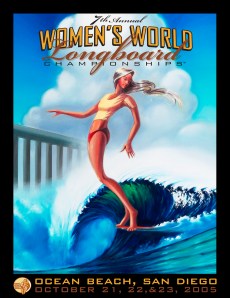
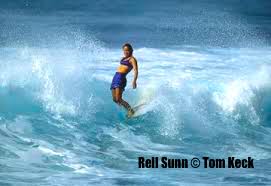 Every share or mention helps and every contribution is tax deductible. We’ve got some great perks to offer as well… like the 20×24 of the iconic shot of Auntie Rella surfing Makaha; photographed, personally signed, and donated by Tom Keck (left) and the beautiful poster donated by Linda Benson, and designed by Wade Koniakowsky for the last independent (non-ASP) Women’s World Longboard Championship in 2005 (top).
Our campaign can be found here.
Our campaign video:
The Inspire Initiative Presents: The History of Women’s Surfing from The Inspire Initiative on Vimeo.


Leave a Reply