
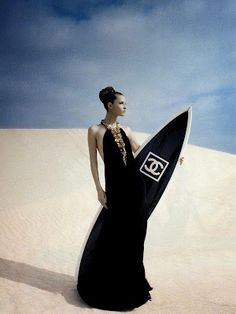
Nº5: #theonethatIwant ?

The new advert for Chanel Nº5, which features Gisèle Bündchen digitally surfing on a wax-less, black board, is making its way through the surf-o-sphere with commentary about how cheesy it is, but it may be the perfect representation of the desired trajectory of women’s surfing as it was created and disseminated by the surf industry since the 1990s.

Here we have the final destination of the white, diamond-studded, self-absorbed, privileged Global North female, who, thanks to a flipped gender script, occupies a traditional masculine role in a heterosexual relationship–that is, out in the water surfing while the man waits at home. Is flipping the overplayed male/female Hollywood script of “who is chasing whom” enough to get us titillated about female empowerment vis a vis surfing? Or can we push a little deeper and ask hard questions about why Chanel has gravitated towards surfing as a way to highlight their particular brand of luxury-consuming, female empowerment? (edit: more on why surfing is used like this in a future post)

The implicit question here: Is Chanel empowering anything other than a woman, a destiny, a perfume?

The Woman: stereotypical white, blonde, heterosexual surfer girl.
The Destiny: nothing more than a guy, who she leaves her “career” as a model to chase.
The Perfume: luxury consumption at $125.00 per .25 ounce.
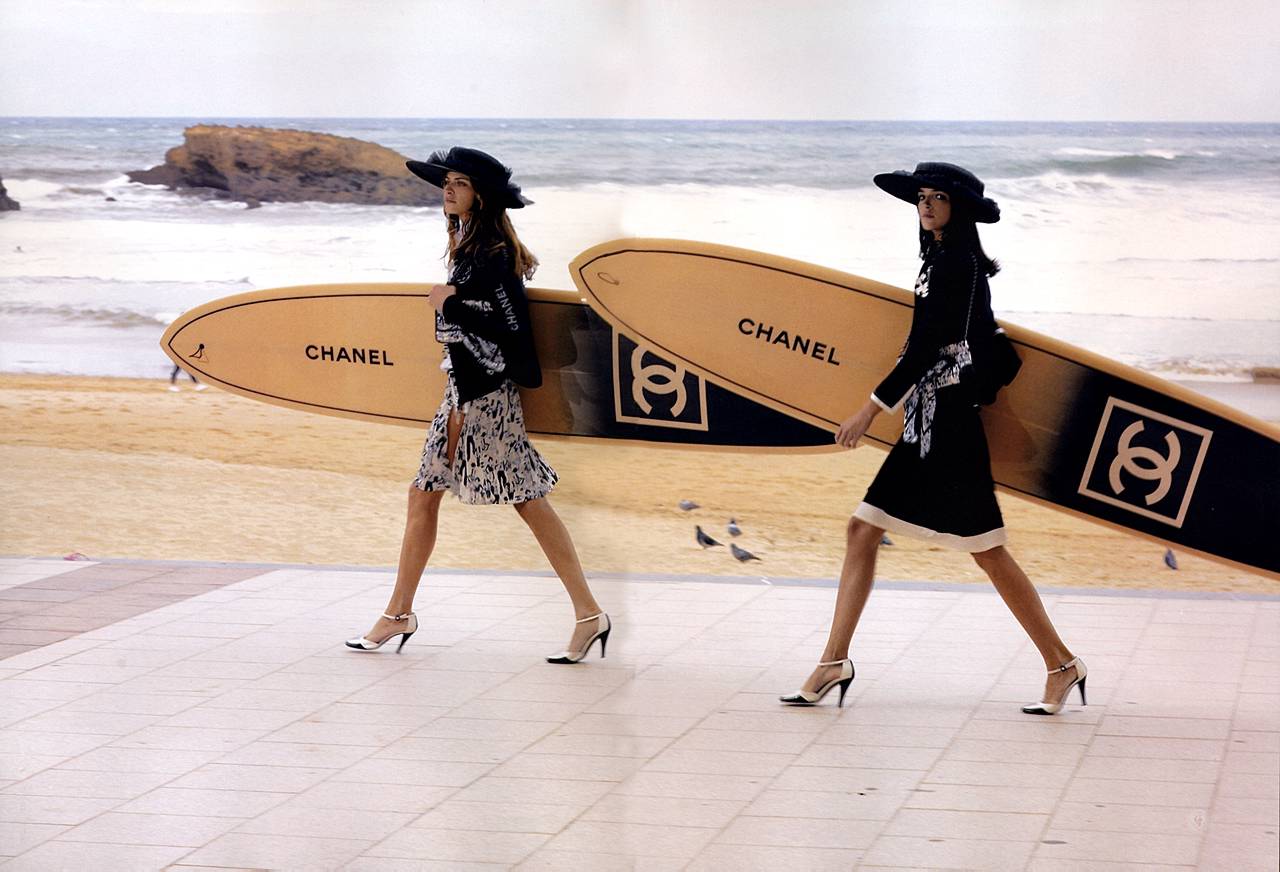
chanel-surfChanel has been flirting with surfing for years, slowly bedazzling the image of the surfer girl into luxury. But is this especially, actually, politically liberating? Or simply a call to wealthy, privileged women to flex their spending power in the direction of a brand that stands upon a cause marketing rhetoric of female-empowerment that is simply a diamond-encrusted-luxury distraction from the reality that 85 people have as much wealth as the 3.5 billion poorest.

This is a rhetoric of empowerment disguising a call to consume, with the always present glitz and glamour obfuscating the Surfeminist question we should always be asking: “at whose expense?” The luxury desires of Global North women are fueling the exploitation of women in developing countries as we rise into our empowered consumption. The surf industry doesn’t want women to think about the who or the where behind their bikinis or clothing. What is asked of surf industry consumers is that they settle into their own feelings of well-being and worth, never mind what lies behind the sandy-blonde, smiling curtain.

Perhaps a look at the history of Coco Chanel herself will help us understand a bit more of the answers to this question, at whose expense, for she may have altered fashion for white, Francophone and luxury-class women, while establishing herself in a male-dominated industry (during an era of US and Euro-female political liberation), but she was also relentlessly anti-semitic, homophobic, and a possible Nazi agent to boot.

Nº5: #NOTtheonethatIwant

Watch the Chanel ad here:

15 responses to “Nº5: #theonethatIwant ?”

  1. ew! that is so mills and boon. and all that butt? do we have alana to thanks for that?

    Like

  2. Thanks for this post Cori!
    I got pinged about this from someone who actually wanted to tribute Coco Chanel, trying to lift and display her as some kind of feminist icon… Which left me a bit confused. See, to me, this is just more of the same bullshit we see in the action sports industry on a day to day basis.
    I completely agree with your analyzes and want to scream: LEAVE ACTION SPORTS ALONE and keep doing the same fashion-crap you have been doing for ever!
    I don’t want this to be connected to the lifestyle I’m living, we have enough to fight as it is…

    Like

  3. Thanks Cori for this exceptional post, I too have some thoughts to share. Each time a campaign like this is released it devalues the spirit of surfing and profits from an unachievable feminine stereotype.

    When the main goal of the female protagonist in this advert is to peruse the man, this sends out a heavily loaded message that is akin to the “Disney Princess problem”. The mass media and in particular the lux media keep peddling this out dated ideology that derives from a neoliberal and capitalist consumer culture.

    ‘As girls and women gain greater access to the sporting culture, there is a tendency to universalize the gendered experience through a masculine lens; I suggest we look to the marginal extremes that upset this phallocentric model in acts of parody, retrofitting, and transcendence.’ (Gileseler, C.M Performances of gender and Sexuality in Extreme Sports Culture.’ 2012)

    Like

  4. Well… Not surprising. Standards of beauty are constructed by the dominating social class, that is to say, from the point of vue of the white heterosexual occidental man from upper class. In the past women had to be chubby and the whiter possible to show they had enough to eat and had no need to work outside at the sun. Nowadays, occidental woman is necessaraly slim because only poors eat junkfood and don’t have enough time to fitness, she has to be sun tanned because it shows you have money to take some holidays at the sun, but yet still white and caucasian as it is the ones ruling the world. So, what I wanted to say is that, an adverstisement for luxury product, targeting the upper class woman will show this vision. Progress will never come from industry or marketing, wich ave always distorted subversive popular movements to empty them frome their message and turn them into mass consuming standards : rock’nroll, rap & hip hop music, hippie movement, the Che figure, even feminist slogan like “One is not born a woman, one becomes one” (Simone deBeauvoir). So we need people to impulse movements, to boycott, to sign petitions, to use new medias, and why we need leading figures like you Cori to raise those movements and ideas.

    Like

  5. I was just thinking… Is Giselle white? She’s 5th generation German Brazilian (thanks wikipedia!), so what dos that mean in terms of whiteness. Not a critique, but a genuine question. I mean, what is whiteness – is it racial, cultural, class-based? I think that needs some clarification in terms of this discussion since the image of Giselle herself is so central to this campaign. Perhaps the image here is a little less about whiteness in this case (although I do take the point) as it is about body type, sexuality and class. I know these are difficult to separate from whiteness as well, but, I don’t know. Just wondering/thinking out loud I guess.

    Like

    1. A good question, one that has been tackled often by far more qualified than I. These days, with so many of us hearkening from mixed backgrounds, how we are “read” by others becomes an important discussion point: that is, how color is lived. We can’t give away our privilege when we present (are read as) white because the privilege we receive is bestowed by others, whether we like it or not.

      Giselle “reads” as white, an especially salient issue in Brazil and in places where there are beauty standards that associate whiteness with privilege and class (see “fairness creams” popularity in India; associating darker skin with the working class-true of Mexican and Chinese cultures among others; extant racisms of nations w/ history of European imperialism/slavery). I think it would be a mistake to downplay/ignore race in the intersectionality mix here.

      “Not black, not white: just the opposite. Culture, race and national identity in Brazil” http://www.lac.ox.ac.uk/sites/sias/files/documents/Schwarcz47.pdf

      Like

  6. To whom does Giselle ‘read’ white? Not necessarily to me. She reads as rich and thin and celebrity, and I can see that there are links to whiteness, but I’ve always seen Giselle’s Brazillian identity as something of an anomaly in a Euro and American focused world of high-fashion. How whiteness or not fits into that world might be tricky in a few ways. She’s light-skinned enough, I get that, but culturally?

    I do agree that race can’t be ignored in this discussion, but perhaps how we are ‘read’ is also something that needs to be addressed – especially if part of the critique comes down to one individual within the text you’re looking at. Because where does that leave the power – has Giselle been asked about this? Has she spoken about her racialized identity one way or another? A critique that gets levelled at readers a lot is the assumptions they make about those their talking about: we both often talk about assumptions made about female identities associated with (a lack of?) femininity, as well as sexuality, so I guess I’m just wondering out loud – and not disagreeing with you, just wondering – how whiteness fits into that practice. Does Giselle’s being white suit the analysis more than it suits Giselle’s understanding of herself? I don’t think that there isn’t a point to be made, but I think the two need to be considered in relation to each other.

    Then again, there’s the company. Why Giselle? What about her was key to this message?

    Anyway, just thoughts.

    Like

    1. She reads as white to me and to others I’ve spoken with, especially my friends of color, who tend to note race more often than I do because racism is a constant, salient presence in every aspect of their lives. I think it is very important not to confuse national identity or culture and race. For instance, one can be 100% American and 100% Latina (as my wife is).

      In Brazil, citizens are permitted to self-identify their race and, according to Wiki (totally legit source, I know… heh), she is listed as a white Brazilian.

      I agree with you that how folks are “read” ought to be something that is always addressed, which is exactly the point of bringing whiteness (and race) into the conversation. We can disagree on how we read her race, but to deny her racial identity completely…? And again, “Brazilian” is not a race.

      The way I do feminism constantly appraises race, as well as class (often associated with body-shape), sexuality, gender, and when present, creed. The critique centers on the full symbol being presented in a global context. Is the individual important, of course! But we are not deconstructing the individual, but the symbol embedded in the text.

      Regardless of what we know about the individual personally, in this marketing campaign, the power remains in the same hands; in the same power structure. Gisele might have chosen (power?) to do the ad, but this was a choice made within the extant structure. It is the structure that presents the symbol. We critique the structure then, not the individual.

      Keeping race central to conversations around feminist critique is an addition from intersectional studies that often gets pushed to the side when Global North feminists deconstruct texts. We don’t “see” race, just like the marketers don’t “see” race… what this fails to address is exactly how tightly wound perceived whiteness is to privilege and wealth.

      An aside…. the ad just popped up on TV as I was finishing this up… a welcome break from the constant drone of political campaign commercials we have going on just now. oye! 🙂

      Like

  7. Argh! No! Just quickly – I was not ever suggesting that being Brazillian is a racial identity! No, not once, never. It’s a national identity as unreal and constructed as race is, but I’m fully aware the being Brazillain is not a racial identity. I really wanted to clear that up because, well, I’m not that much of a moron. (I also know that Africa isn’t a country.) But maybe that misunderstanding is at the centre of what I’m trying to say. Am I supposed to call her white when I’m not sure she is? Black? Is she that? I’m just not sure where we would ‘fit’ Giselle other than white, but that doesn’t work, so then.. what? Hence, referring to her Brazillian identity as a way of referring to how her whiteness or otherwise isn’t so straightforward. I think that’s actually super cool on some levels, while also understanding the politics of light-skinned people in relation to identifying with non-whiteness. I’m from Australia where light-skinned indigenous people suffer (amongst many other things) people reading their Aboriginality as incomplete or inauthentic because their skin isn’t dark enough – this comes from within all aspects of Australian society. Having heard those debates and seen the hurt they can cause, I suppose I have questions about reading light skin as ‘whiteness’. In part that is what I’m asking about – is whiteness racial? Perhaps it is a product of economic, cultural and bodily life, rather than racial – a category that is as highly problematic as ‘gender’ and ‘sexuality’, problems that lie at the heart of intersectionality.

    I understand what intersectionality is, Cori. I’m not suggesting that we don’t engage in complex and messy discussion of identity, I’m just, as I said, wondering out loud, which is part of my doing of feminism.

    Asking a question I can’t answer does not make me ignorant of debates surrounding race, feminism or other forms of identity politics. Asking questions of theory and critique is an important part of thinking and doing critique. Racial politics are so incredibly important, and as a white woman I’m aware of the sensitivities and difficulties of my engaging in these debates – how can I possibly ever understand the weight of racism when I carry so much privilege by virtue of my skin? Not possible. Please don’t mistake my questioning of Giselle’s proposed whiteness (not her race, her whiteness) as a denial of the unbalanced power, privilege and prevalence of whiteness in all aspects of contemporary life. I’m just asking a question of what the reading of her whiteness could mean and whether it could be even further complicated in terms of this analysis. I suppose, in this case, I’m wondering what whiteness is.

    But I’m certainly not suggesting that being Brazillian is a racial identity.

    Like

    1. Sorry if I misunderstood, Bec. That was a bit hard for me to unpack.

      I hear you on the complexities of the authenticity of Aboriginality based on skin color. This is distinct from the experiences I have been privy to and read about more broadly where lighter skin is desired to the point of kids being bullied to stay inside (more often with girls), plus all the lightening creams and facekinis. I think this highlights a difference between local vs. global racial issues.

      The intellectual space that I am coming from is embedded in a series of racial incidents here erupting from a decade and a half of race-denial and political correctness (far more racial tension than this over the course of time, clearly, but the pot is boiling). So for me, whether or not whiteness is X or not was less at the forefront of my thinking in the face of the violence it enacts, implicitly and explicitly.

      If I’m understanding correctly, your thought was about the social construction of identity and who gets to determine said identities, and how that plays out in power hierarchies? Am I getting closer to unpacking your original query?

      Asking what whiteness is must necessarily engage with what whiteness is not. Whiteness is not culture. Whiteness is not static, but fluid (many colonial shades) and mobile. Whiteness is not suited for the outdoors without proper (consumer-based) protection, service, luxury, air-conditioning… whiteness is the color of capitalism.

      Whiteness has been intimately tied to capitalist aspirations and dispersed in the neoliberal model we have come to know since the Reagan/Thatcher era. It is as important to highlight whiteness in this critique for the same reason it is important to highlight the dreamy, familial heterosexuality (nuclear family unit as foundational unit of capitalism), among other things.

      Hope I’m edging closer to what you originally had in mind re: theory and critique?

      Like

  8. Just thinking still (and please note that I’m writing this between sets of burpees and squats in my loungeroom to a playlist that includes a plethora of perky pop tunes – whiteness magnified! Ha!)…

    It would be really interesting to ask some more questions of your wife and your friends who identify as Giselle as being ‘white’, about what it is about Giselle in that advertisement that they identify as being white. That would be really interesting and insightful I reckon. How DO we identify whiteness beyond pale skin, especially in such an extravagant context like a Chanel ad? I mean this ad is made by a white guy, who was commissioned by a white guy for a company with whiteness historically key to it’s very French identity. Maybe there are aspects to this whiteness that are personified by, but beyond, Giselle. Is she performing an extreme version of whiteness? Then what is that? I don’t know that I could answer that question very easily, or in a way that wasn’t stereotypical, especially given how many of my friends have not-white heritage that I’ve never asked them about. I think it’s a great question though – super interesting! Especially in the context of this ad and discussion. I’ve really never thought about it before, which is a total indictment on me. Huh.

    Like

    1. Followed your suggestion and asked both surfing and non-surfing friends of color about the ad… all read Gisele as white and described why. “Wealthy, surfer, independent, mobile, strong” were some of the words used most often (other than her features: skin color, hair, bone structure).

      After telling my Latino friends she was from Brazil, they were surprised. If Gisele was permitted to speak in the ad, allowing her non-native English speaking primary language to emerge via an accent, they expressed that this would have complicated their assessment. My wife has often noted language as another source of discrimination among native English speakers in the US with an inbuilt hierarchal structure that places European accents (minus Spanish and Portuguese) at the top of the pyramid and Spanish and Spanish-sounding accents at the bottom, especially here in the US, where Spanish-sounding accents are identified with Mexicans (regardless of their actual national identity) and interwoven with White US citizens’ fears of immigration. This language discrimination is of course not limited to native English speakers toward non-English speakers. My aim was simply to highlight an interesting trend that persists in placing native English speakers and certain traditionally white-identified Europeans at the top of an old hierarchical social structure.

      The way this difference manifests in conversation, from the top to the bottom of the pyramid, has been described to me, regardless of physical appearance, as the difference between an adult speaking to: another adult with good hearing (top) or a young, mentally handicapped child who is nearly deaf (bottom).

      ~

      “…race, and in particular whiteness, must be situated in the global context. It appropriates the concepts of globalization—such as multinationalism, fragmentation, and flexibility—and applies them for the study of whiteness. In short, it argues that, like the economy, whiteness as a privileged signifier has become global.”

      Click to access SoulsofWhiteFolk.pdf

      Like

  9. Thanks, Cori! 🙂 (Sorry I disappeared – I’ve been flat out with work)

    That’s what I was thinking about – what makes someone white beyond looking white, and what does that whiteness represent? Wealth and mobility are important points in this case I think. (I might add ‘thinness’ too, which has a particular ‘white’, western and economic morality attached to it as well.) The answers around the complexity of how she would be read if she spoke (IF she was given a voice) are really interesting too. It was just an aspect that – because of her national identity, one not necessarily associated with whiteness or with global north luxury brands – stuck out for me as more complicated in terms of whiteness than if they had used, for example, Keira Knightley or Claudia Schiffer.

    I really appreciate your friends and your wife answering those questions – really – because their readings and points open up this analysis to even more complexity, diversity and depth!

    I think that if we do talk in global terms, then thinking about these concepts beyond our own understandings – which is what intersectionality enables! Yay! – is really important. But I also think it’s really, really difficult. I find it to be so anyway. For example, how whiteness is seen in Africa is interesting, because Albino people totally don’t fit into that. Their whiteness is racial – it’s genetic, right? – but it’s hardly European. It’s also highly dangerous in some areas. And whiteness, like in Australia and NZ, is attached to colonial invasion, which is also a story for some people in the USA, but different to the experiences of African American and Latino people. The stories of whiteness in the USA are not global ones, but they are ones linked to global marketing and consumptions culture, which is pretty interesting. And that’s only just touching on nation and globalisation!

    Anyway, your post and points made me think, which is the point, right? Awesome stuff, Cori. And also awesome that you asked those questions. I think that’s really cool.

    Also, are they PEARLS on the cuffs of the Chanel wetsuit? Oh man. There’s a whole other story there… Also, I prefer to pronounce Chanel as ‘channel’. Maybe now with their surfing stuff, it will work better anyway?

    P.S. I’m going to be in Portland next week if, by any chance, you happen to be in the Pacific Northwest? x

    Like

    1. Enjoyed digging deeper into this, thank you! One of the eye-opening things I’ve discovered along the way with our convo, and am grateful for, is the distinction between whiteness, white culture, and white people, which the paper I linked to delves into a bit. Def. going to be thinking more about this.

      I didn’t notice the pearls on the ‘channel’ (works brilliantly!) wetsuit! Seriously?! Bizarro world.

      Wish I could swing up to see you when you are here! I am looking forward to the day we can sit and have a chat in person, Bec. Feels like we have so many amazing conversations in front of us. Thank you!!

      Like

  10. The deal is, either you surf, or you don’t. If surfing is devalued because of ads like this, great! Less kooks clogging up the peak.

    Like

Leave a Reply