
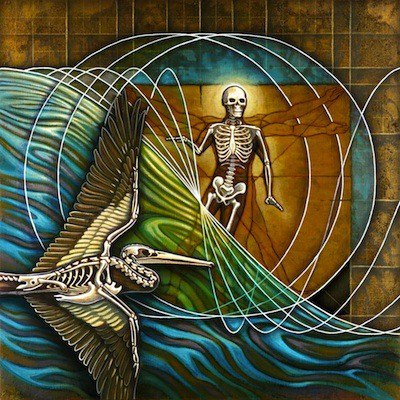
What does the swallow think of the pelican’s flight? Does Swallow wonder at Pelican’s lack of movement? Does Swallow gape at the protracted lengths of Pelican’s glide? Swallow’s agility and quickness allow it to escape hawkish predators Pelican does not fear. Swallow treats the updraft flurries of salted draughts that press against cliff sides like a playground while Pelican regally insists on drawing horizontal lines against vertical gusts.
Swallow, almost a bee–this fragile winged one who jerks its beak groundwards and rightwise to catch the vivisecting glide of the great grey bombers above with an obsidian eye–with an almost hummingbird’s heart, searching its body for some knowledge of the long-beaked, cackle skin-necked endurance flyer. Swallow bloats its body in a ruffle of feathers and chirps. Swallow has sat too long and leaps from its perch atop sandstone cliff. Tail flicks, and Swallow has changed direction thrice in a second. Swallow’s memory is likewise curtailed.
What does Pelican… Stall: Pelican is rapt, caught in the flow. Pelican has merged with wind’s current and other pelican bodies in v-formation. Pelican is in a slow-motion perpetual motion machine of feathered bodies, riding wind updrafts above cliff sides and wave troughs, executing unseen maneuvers to maintain–forward flow.
Ways of flying and perspectives on flight are determined by the bodies of birds. Not so with humans and their tools of glide upon the faces of ocean swell. Though we may be inclined to stick to one type of surfboard or another, we can readily switch our equipment and so transform our perspective of the liquid bumps we play upon.
I enjoy switching my surf equipment: to remind myself that I cannot catch every wave; to remind my body that it has more flex and spring than it gets credit for; to reorient my status in the line-up to zero (the gestalt-shifting experience offered by body surfing); to discover different poetic parabolas; to confuse the dignity of a body that believes it knows the way to walk the surprising contours of a life in flux.
The stories of others likewise disrupt entrenched thinking, narratives, modes and patterns that one can become blind to, that one believes are so natural they have become invisible. What is the story of the sparrow to the pelican who never gazes down save to eat?
Though both share the same ecology, the same billowing currents and land formations, their paths rarely cross. Yet in their bodies, in the hollowed bones they share, there is an embodied similarity dictated by the forces they ride. That their desire for flight is different is less important than the fact that they both willingly take to flight when shoved from their nests.
Birdwatching humans readily enjoy the biological exuberance of birds. They appreciate the skill of the sparrow and the grace of the pelican (the heart of the way that birds tell their stories is in the way they fly as in the way they sing) without moral judgement. Yet we cannot do the same for each other?
Taking this idea further, how is it that surfers (quintessential enjoyers of nature), when presented with the biological exuberance of loving cannot find it within their experience to understand the importance of talking story that is at the very heart of our playful tradition? Yes we dance upon waves, but we also talk amazing stories: stories of grace, stories of faith, stories of survival, stories of conquering, stories of renewal, stories of discovery.
Why is it that when presented with a documentary on gay surfers, many want a “Don’t Ask, Don’t Tell” anti-narrative. When straight surfers tell their stories, often they rely on a narrative that is related to heterosexual love. The relationship of surfer to sea is often portrayed as the relationship of male to female. A sexual and love-obsessed relationship most often seen through the eyes of an entrapped male gaze. The ocean is the woman you can never leave, who abuses you, pleasures you, takes everything from you (including your human relationships) and demands absolute attention to her in her presence. Not even fear has a place between she and thee.
This heterosexual bias is what surfers don’t see, what is invisible, the “blind spot” that speakers of such comments as we are seeing as a response to “Out in the Line-up” simply can’t get past.
I get it. I do. I am in a relationship with a Mexican-American surfer lady (who had to deal with all the Orange County, Ca. racist bullshit that surfing was built upon) who has quite patiently put up with many of my own blind spots. I am a caucasian, queer woman and as much as I would like to claim a 360 degree clarity, I have many, unexpected blind spots. These blind spots are only exposed when stories, narratives and the perspectives of others are bravely spoken. I literally don’t know that I am missing something until it is pointed out explicitly to me… and as someone who also struggles with a pretty severe hearing loss (another damn “blind” spot), I appreciate when someone takes the time to make sure I understand. That is, I may not even know that I haven’t understood something correctly until someone cares enough to check to make sure I do.
It isn’t that I am an idiot or that surfers in general are idiots (in fact I believe that the line-up, and your average surfer, are far more progressive and compassionate than the industry that presents surf stereotypes to the public-at-large) with our blind spots, but that a group of surfers cares enough about us all as a global community (past, present and future) to make sure that we can all fly together, openly, regardless of how we desire.
Diversifying surfing’s populous narrative is a step towards creativity and innovation, and invites future surfers to develop new narratives that continue to challenge our unresolved blind spots. Amplifying diverse narratives in surfing is not only an ethical imperative, it signals a renewed commitment to creativity in surf storytelling. This creativity is the mode through which surfing will reclaim the surf narrative from those who worked to make it a monolithic and soulless.
Diverse surf narratives matter.
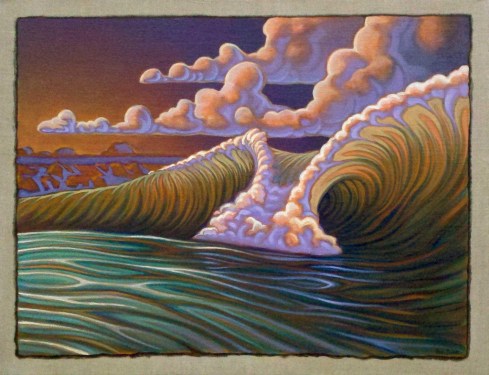
(all art used in this piece is by Matt Beard, an exceptional artist I have fell in love with.)


Leave a Reply