
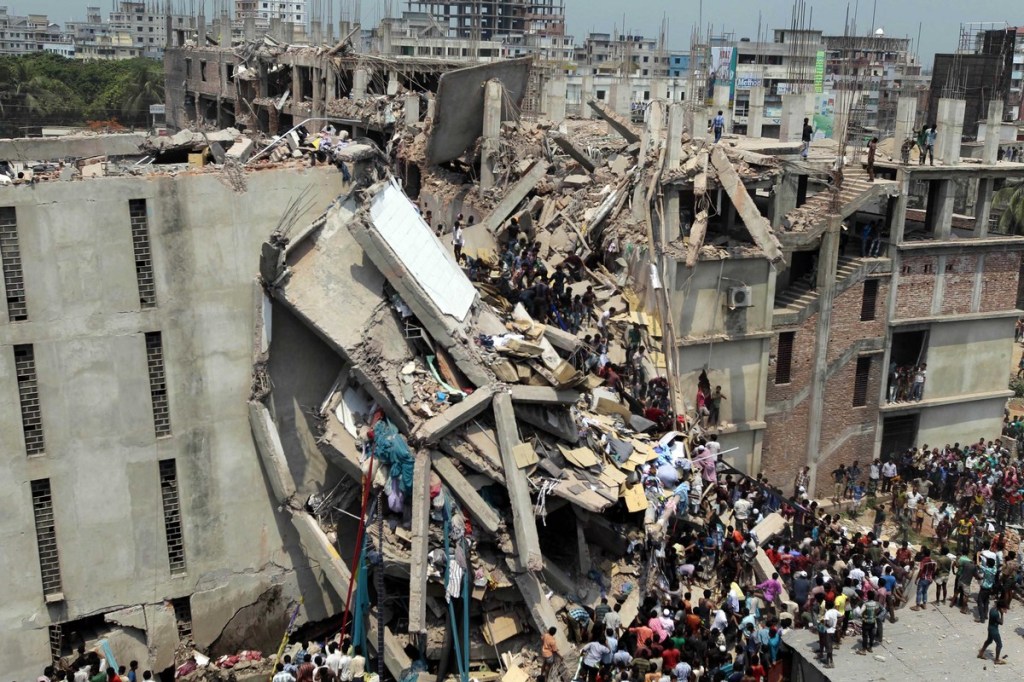
ONE YEAR LATER: 4/24/14. Parent company of REEF and VANS, VF Corp, continues to refuse to sign Bangladesh accord.
Updated 5/30 : Along with VOLCOM and REEF, I found BILLABONG men’s shorts, Made in Bangladesh 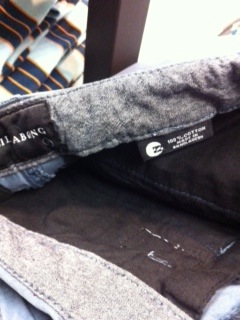
Updated 5/26 : Bangladesh factory banned by Wal-Mart is still used by the VF Corp (see note 2 below), the same corporation that owns VANS, REEF and NORTH FACE, as Bangladesh factory workers escalate demands for better working conditions.
Wednesday April 24th, a fire broke out in a Bangladeshi clothing factory that ultimately left at least 1,127 factory workers, mostly female, dead. This is not the first time clothing factories manufacturing products for Europeans and Americans in Bangladesh have had such devastating dilemmas (though it is the worst incident the world has seen since the 1984 Bhopal disaster in India). Indeed, between April 24th and today, while recovery operations continued at the Rana Plaza collapse site, another fire broke out in Bangladesh’s industrial district Dhaka, killing 8 more factory workers.
Such catastrophes expose consumers to the dark side of their unwitting demand for fast, cheap fashion as well as making salient those companies that play Russian roulette with the safety of their workers and the health of the environment in order to increase short-term profit. It is unfortunate that it takes disasters such as this to move both consumers and corporations to demand the modification of the sourcing of textiles, dyes and manufacturing toward a more ethical and sustainable operational mode.
I wonder about surf clothing…
While much of the shift in global surf brands towards more sustainable manufacturing has been in the area of hard-goods (ostensibly it is less “political” to work for the good of the environment than for workers rights in far away countries with Free Trade Agreements and/or less stringent or easily bypassed regulations around compensation and work hours), the clothing and textiles industry are incredibly dirty industries (as explained by new Quiksilver Global Head of Supply Chain, Kasey Mazzone in this web seminar from 2012, when she was still the Senior VP of Sourcing at Lands’ End).
I was curious about the countries of origin of the surf clothing industry (see note 1 below) after reading about the fire and factory collapse in Bangladesh so I visited one of the largest retail surf shops in North County to get an idea of where the majority of surf clothing by the largest surf brands (Quiksilver, Billabong, Hurley, Rip Curl, Volcom, Reef, Vans, Roxy) have been sourced. I found that there were several distinctions between male and female clothing as well as differences along the lines of casual t-shirt/trunks and the more dressier fashion (i.e. button-down shirts for men and dresses/dress-shirts for women).
Many of the men’s dressier clothing is made in India while the majority of the t-shirts and trunks are made in places like China, Vietnam, Guatemala and Mexico.
Women’s clothing, perhaps due to the current fashion trends, is by and large made in India with many of the bathing suits and t-shirts made in China. Of note, I did find a couple of Roxy shirts made in the USA.
I documented one Volcom item that was made in Bangladesh from their early 2011 “Corporate Class” line of clothing (Volcom through their corporate parent, the Kering Group, have since 2012 enacted new initiatives to prevent instances such as these in the future), and Reef hats that were also made in Bangladesh (see note 2 below).
What this verifies, more than anything, is that the surf industry is indeed a global industry that uses multiple countries of origin for their products. But how does the industry go about ensuring the safety of those who make their products?
Patagonia (see note 3 below) founder Yvon Chouinard makes a compelling case for what he calls a sustainability index that would indicate which products are being “produced responsibly” (link to video-> start at 26:45 minutes). In this same video (at 20:25 minutes), Chouinard explains what happens when a surf company does not evolve with its demographic. This is an especially grounding argument given that during the recession, when the surf industry saw its profits tanking, Patagonia grew over 25%. Chouinard contends that the reason for this is Patagonia’s commitment to producing according to its core values, to not simply vomiting a green ( even the Nazis were green), values-based rhetoric (what Chouinard called “the bullshit”) like other companies, which the new demographic of consumers can see right through. The numbers seem to support Chouinard’s contention.
How did Patagonia maintain its integrity and commitment to a clean supply chain (human and non-human naturecultures and environment alike)? Through a 13 year ongoing partnership with Bluesign Technologies. This was accomplished to such a degree that Nike Inc. took notice and recently began its own relationship with the independent Swiss company.
Why wouldn’t the large surf brands, with ample knowledge of Patagonia’s methods, partnerships and business gains (despite a “no growth” business plan) follow suit?
Crux Problema
The answer to this question is less straightforward than it first seems and quite possibly it is the wrong question to ask.
Solutions to these dilemmas seem to come in three parts: consumer, retail, corporation.
The pressure to change must come from consumers and be communicated to retailers (via the buyers) who then pass the news of changing demands on to the corporations. Consumers can also communicate to the companies directly via letter writing campaigns, petitions and boycotts.
After the Bangladesh catastrophe and the uproar that ensued, clothing companies that were willing to take responsibility and enact change, signed a Bangladesh Factory Safety Accord. Others did not.
Who can say why these companies chose not to show solidarity with the mostly female workers who were killed (or their families) in order to stock brightly lit retail spaces in the West. What can be said is that public pressure from consumers and exposure (no one wanted to admit they had product in this building but material products were found and publicized and corporations were forced to admit their error) drove companies who had initially refused, to sign the accord by the deadline.
Letter writing, petitions, boycotting… pressure and exposure… change from the bottom up… but only after a massive disaster and a mind-boggling loss of life.
Kasey Mazzone, new Quiksilver Global Head of Supply Chain, admits that risk management and contingency plans fall to whomever is in charge of sourcing and their team and that often, the CEOs, et al. don’t want to hear about the nuts and bolts of production and manufacturing… as long as everything is delivered on time. At the beginning of this particular webinar, she says (after racing in late to the panel) that the main issue she foresees from 2012 through 2014 is speed, the rate at which a company can keep up with the demands of a consumer base whose rapidly fluctuating tastes for disposable fashion drive businesses to demand the impossible from their manufacturers (invariably South Hemisphere, non-white, low-paid workers). Risk management and contingency plans become the norm because catastrophe is inevitable.
I’d love to offer up Bluesign Technologies and other social auditing firms of high repute as solutions, but they are merely band-aids with no guarantees in much the same way that “alternative” or “green” energy sources are band-aids. The core problem is not where we get the clothing or energy. Ultimately, we must address our insane demands and face the fact that our consumption itself is unsustainable. Our consumption habits are what need to change. If we don’t, ridiculous claims such as those made recently by Monsanto might begin to hold water. After all, if we aren’t willing to curb our consumption, technology and those who own it, will determine all of our futures for us because there will be no alternative. The question “Why can’t I consume like you?” is a valid one and deserves an intersectional analysis (taking into consideration classism, racism, the entitlement of the Northern Hemisphere).
During the interview with Chouinard, the interviewer noted that Patagonia was seen as an “authentic” business implying that the values the company says it is committed to, it actually is committed to, and (most importantly) consumers viewed the relationship between the company’s values and its actions as inviolably married.
Chouinard was asked by the interviewer how companies could project themselves as “authentic” if consumers did not perceive them as such. Chouinard shrugged and said that he didn’t think he could answer the question. Maybe, he pondered out loud, maybe they simply aren’t authentic… maybe consumers, especially this new generation of buyers, can see through “the bullshit.”
“The bullshit,” as it were, is not some projected authenticity (after all, is Nike Inc. now more “authentic” or “in integrity” now that it has partnered with Bluesign Technologies?) or the intimacy with which a company clings to its values. “The bullshit” is how we consume and not asking or ignoring who has to pay for it, with their bodies, their minds, and their hearts. I hope the next generation can see through the bullshit… and I hope it’s not too late.
Notes:
1. I am leaving out wetsuits here for brevity but the “Made In” tags and the sourcing of neoprene, glue, taping, etc. for the suits are also areas in need of attention.
2. 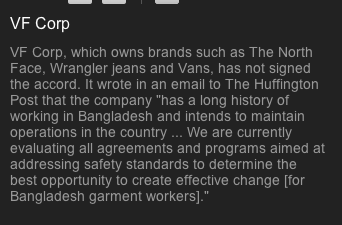 VF Corporation owns the brands The North Face (also partnered with Bluesign Technologies), Reef and Vans and refused to sign the Bangladesh Accord.
3. A little about Patagonia: 85% of Patagonia’s workforce is female. Patagonia’s business plan is no growth and sustainability in its global stores. The company provides on-site childcare for its employees and flextime for surfing and mountaineering. Chouinard cofounded the One Percent for the Planet Organization. (K. Comer, SGNWO p. 238, note 89)


Leave a Reply