
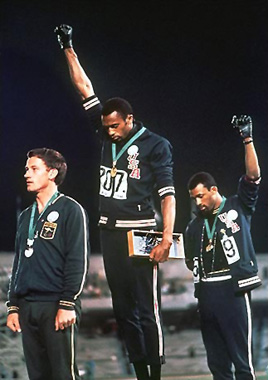
 John Carlos and Tommie Smith
Forty-three years, one month and one day ago, two American athletes took the platform at the Olympic games in Mexico City to accept their gold and bronze medals. As the Star-Spangled Banner was played and the American flag crept up the flagpole, the two men took black gloves from their pockets, slapped OPHR badges onto their uniforms and raised an arm to the sky. With bowed heads, shoeless feet and clenched fists, they silently made one of the most veraciously overt political statements the modern Olympic spectacle had seen.
The reaction was what one might expect, from fans who ferociously protect their sacred sphere of sport, and more. Sports fans and athletes alike screamed, “Sports is no place for the political!” and John Carlos and Tommie Smith had to live through many years of harassment, obnoxious comments by journalists and even death threats.
Though time would prove these two men to be true heroes, they “sacrificed privilege and glory, fame and fortune, for a larger cause – civil rights (Carlos & Zirin, 2011).” This was not the time of massive sponsorships or huge endorsement salaries that we see today, so it might be argued that they didn’t give up much (quite a naive and entitled view). Still, they traded their years of effort, many hours invested in training, preparing psychologically and physically, and were willing to take the moment of their victory and redirect it in order to make a statement about the inequality of Blacks in the late 1960s.
We live in an era within which our ethics are changing. Peter Singer argues in One World, the ethics of globalization, that our value systems evolved in a seemingly endless environment with boundless resources. The boundaries of our rights were clearly defined:
“The right to swing my fist ends where the other man’s nose begins.” -Oliver Wendell Holmes, Jr.
Globalization, the internet, climate change, rampant corporate opportunism and profiteering demand that we alter our value systems to include a more expansive ethics, both in time and space.
Carlos and Smith, had a more expansive ethics than most. They knew that the world around them held immense inequality for Blacks; that there was more work to be done at home in America, as well as in South Africa under apartheid, though they had never visited the country. While those who were privileged dogmatically pushed an agenda of the obfuscation of politics in sport, ignored glaring political issues in sport (athletes of color, women in sports, homosexuals in sports…) or outright denied there were overarching social issues to be addressed (the US and the Olympics were using Black athletes to advertise the illusion of non-discrimination despite actions to the contrary), Carlos and Smith used their cultural capital in a way that transcended their occupations as athletes and gave suppressed whispers a symbolic voice that became a watershed moment remembered to this day. Our roles should never supersede our humanity. This is what made these men truly great. They never surrendered their dignity as human beings to fame, glory, roles, jobs, social pressures or the status quo.
The following is an excerpt from the recently published book, The John Carlos Story, that speaks poignantly to the cultural paradigm that seeks to “keep politics out of sports!”
We are constantly told that “sports and politics don’t mix.” The great Howard Cosell, in a venomous critique, once said that this was “rule number 1 of the Jockocracy.” The supposedly pristine idealism of sports, of competition on an equal playing field, was to be quarantined from that nasty political netherworld where ideas and social concerns threatened to ruin the party.
Today, major sports columnists deliver a flurry of verbal body blows to any athlete who dares to take a political stand. But in an era when the building of publicly funded stadiums has become a substitute for anything resembling an urban policy; at a time when local governments build public stadiums on the taxpayers’ dime, siphoning off millions of dollars into commercial enterprises even as schools, hospitals, and bridges crumble, one can hardly say that sports exists in a world completely distinct from political concerns. When the sports pages are filled with lurid tales of steroid use, high-profile sexual harassment suits, and endless speculation about the personal lives of players like Ben Roethlisberger and Tiger Woods, then we’ve entered a realm of sports reporting as tabloid distraction instead of as a lens to better understand our world.
Critical is the understanding that sports can also be a place of inspiration that doesn’t transcend the political but becomes the political, a place where we see our own dreams and aspirations played out in dynamic Technicolor. “Politics” can seem remote and alien to the vast majority of people. But the playing field is where we can project our every thought, fear, and hope. We want to believe fiercely that it is the one place where ability alone is how we are judged. If you can play, you will play-no matter your color, class, sex, or ethnicity. This is why boxers like Joe Louis and Muhammed Ali, Olympic stars like Wilma Rudolph and Jim Thorpe, tennis players like Billie Jean King and the Williams sisters, are viewed consciously or not as political beings, carriers of the dream that the playing field for all of us might be made a little more level.
The Fists of Freedom


Leave a Reply