
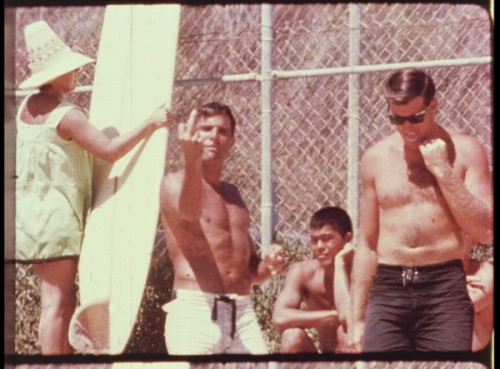
Once, surfing was a haven for those dismissed by society-at-large, shunned or otherwise despised by a protestant-work-ethic-entrenched culture and beloved from within surf culture, as deviants.
The July 2011 issue of Surfing World from Australia, which focused on misfits, oddballs and eccentrics in the surfing world, asks:
“Surfing has traditionally been the great refuge of misfits but do you think that’s changed in the past 30 years? Is the rebel a creature of surfing’s past?” The very fact that a surf magazine has a “misfits issue” is telling in and of itself.
This conversation can be found elsewhere, that is, the dialogue within which it is asked:
“Why is it that this supposed non-conformist culture has become so conformist?”
While consumerist surf culture–Big Surfing–may be marching along to its own seemingly steady drum, answering this question with dollar signs, on the fringes and at the base of surf culture, there is a growing unrest that is saying, “Big Surfing no longer represents the actual culture of surfing.” The argument can be made, of course, that it has never represented the actual culture of surfing. Yet it does seem as if today, with the emergence of the internet and blogs that exist outside the reach of Big Surfing’s advertising dollars, along with a growing volume of dissatisfied opinions regarding Big Surfing being freely circulated, that this sentiment has grown from a few grumbles to a fever pitch… maybe even to a movement.
What has for some time been a “top-down” defining dynamic is wobbling, at least to the extent that the new editor of Surfer Magazine, Brendon Thomas, feels a need to address some concerns in his recent op-ed in the September 2011 print edition of Surfer. While this is by no means an admission of the influence of Big Surfing on mainstream surf media, (indeed, it professes to be much more–a denial), it is of much interest to note the tone:
“If you are the kind of critic that laments that we’re a puppet to the Man and say things like ‘surf industrial complex’ and are currently taking mental notes that you’ll later post on TheSurfIndustryStoleMyCulture.com, I’ll save you some time. … For the record an advertiser didn’t pick our cover. Never has. At least not since I’ve worked here. Nobody bought any editorial. Money didn’t influence the direction of a single page, in fact.”
It might very well be true that during the short tenure of Thomas as Editor-In-Chief, no advertiser may have picked the cover or influenced editorial… yet. But Thomas was certainly present in March of 2010, as Managing Editor of Surfer Magazine, when Zach Weisberg’s article addressing racism in surfing was unceremoniously yanked from the Surfer Magazine website after pressure from advertisers.
Then there was the silence surrounding AI… Indeed, it is the silences, the denials and the gaps that elicit the most doubt regarding the authenticity of many assertions made by representatives of Big Surfing.
I twice wrote the author of the above “pitch”, to get a comment from him regarding an article that was commissioned and green-lighted by his predecessor, Joel Patterson (now employed by Surfer under the moniker “Editor At Large”), that has never seen the light of day.
The article, which I was fortunate enough to read through in its entirety, tackled the perniciousness of homophobia in surfing including the constant use of homophobic slurs in surf culture. It pulled in quotes from various pros (yes, I was among these), ASP leadership and surf industry executives. It is a piece of journalism that was well written, well researched, well sourced and timely. I requested an explanation for why the article was not printed (those included in the article were told by the magazine it was scheduled for publishing this past February). I have yet to receive any feedback of any kind from Surfer Magazine and without the courtesy of a response, I can only assume (given past patterns) that the article has been killed in the hopes of stifling dialogue.
While I believe that Thomas aligns with his statement that “SURFER offices are… where children act on their every whim and do exactly what they want… without consequence or reprisal,” I also believe that this admitted puerility lends itself to the silencing of dissident voices offering complex cultural content within said offices. But certainly, not without consequence. I think he underestimates the growing number of gay surfers who are looking forward to starting a dialogue in the mainstream media and with Big Surfing. Actions, or inactions, like these continue to sour the waters between Big Surfing and surfers, surf fans and the base in general.
I am still waiting for the “pitch” to be proved, though not the proof proffered, namely, a two-page article on body surfing… which is in actuality, a pitch for Keith Malloy’s first film, Come Hell or High Water.
The essence of this issue is less about “the bible of surfing” per se, or even mainstream media in general, and more about how the symptoms of chasing corporate money continue to manifest themselves with those who associate intimately with Big Surfing. There is a definitive change happening within surf culture. It has grown too big and has been apoplectic for too long. We stand at a precipice of change as a culture where even those within the hegemony acknowledge there is a fracturing occurring. While many continue to bemoan the seeming inalterability of the “surf industrial complex” it is important to note the growing reactiveness and defensiveness that has begun to ooze from the internals of said complex.
There are multiple views of the fracturing, endemic and extrinsic, that include: that the fragmentation is some type of evolution, or that the culture is being overwhelmed by hollow consumerism, or that too many people have jumped on the surfing bandwagon and overpopulated surf spots (these last two echo the case Miki Dora himself espoused when the Hollywood Gidget mayhem surged onto the beach in his era, prompting him, in 1967, to drop his shorts, flashing “his bare ass whilst riding the length of First Point” in front of thousands of spectators at Malibu).
The fracturing isn’t so much about what equipment we choose to ride or whether to compete or not or who launches airs vs. who carves… It is, rather, about the very ethos of our surfing. What was once a clan of deviants, misfits, oddballs and eccentrics has become anything but, as represented by Big Surfing.
The point is that when Big Surfing seeks to silence conversations or ideas that are deviant (and there are far more examples than these), it must be said that it has already lost its credibility. What is left to be determined is how it… no… how we will progress.
We are past the tipping point and must learn to shape the progression of our surfing rather than opposing Big Surfing at every turn. Big Surfing is reductive and any opposition to it will shrink proportionately. We need deviant ideas, more innovation at the base and creative solutions to the status-quo. With all this energetic connectivity, we ought to be transforming our collective ire into something productive; ideas that change the trajectory, throw the game and ultimately claim a more democratic hold on surfing and surf culture.
–
*This piece was published in Kurungabaa’s print journal: No. 1, Vol. 4 during the summer of 2012.
(I tried to locate photo credits for the above photo of Miki Dora, but could not find any info… if you know the photographer, let me know and I will give credit where it is due!)

“Gone, The Deviants” by Cori Schumacher is licensed under a Creative Commons Attribution-NonCommercial-NoDerivs 3.0 Unported License.


Leave a Reply